Planning Analysis ReportSeptember 15, 2026
5-13 Kingsley Avenue
Rowan Park, Town of Linden Vale, Ontario. Zoning By-law Amendment and Site Plan Approval for 16 three-storey townhouses on a private lane.
At a glance
Bottom line
The rezoning is supportable in principle. Site Plan Approval needs a second submission.
Townhouses fit the Low Density Residential designation, the rows face the street correctly, and every governing height complies. None of the open items looks fatal. They clear in this order:
- To confirm
Official Plan density
The Town decides which geography the 20 to 30 u/ha range tests. An amendment is needed only on a parcel-scale reading.
- Revisions required
Zoning by-law
Three reliefs are drafted. Visitor parking, the holding symbol, and yard mechanics are missing.
- Critical
Sanitary servicing
Downstream capacity is exceeded. The zone becomes R4-XX(H) until an allocation is confirmed.
- Second submission
Site plan clearances
Updated groundwater work, a fire and waste turnaround, and a finalized site plan.
16
Townhouse units
Three storeys, 7 rear-lane and 9 front-lane
0.29ha
Site area
Five registered lots at the Kingsley and Hawthorne corner
10.34m
Governing height
Under the 12.0 m limit on every drawn building
CompliesR4-XX
Zoning path
Rezoned from R2-3 as a site-specific exception with three reliefs
Relief required55.2u/ha
Site density
18 to 19 u/ha across Phase 2, against an Official Plan range of 20 to 30
To confirm0of 2 to 4
Visitor spaces
No dedicated bays on the plan on any reading of the by-law
Deficiency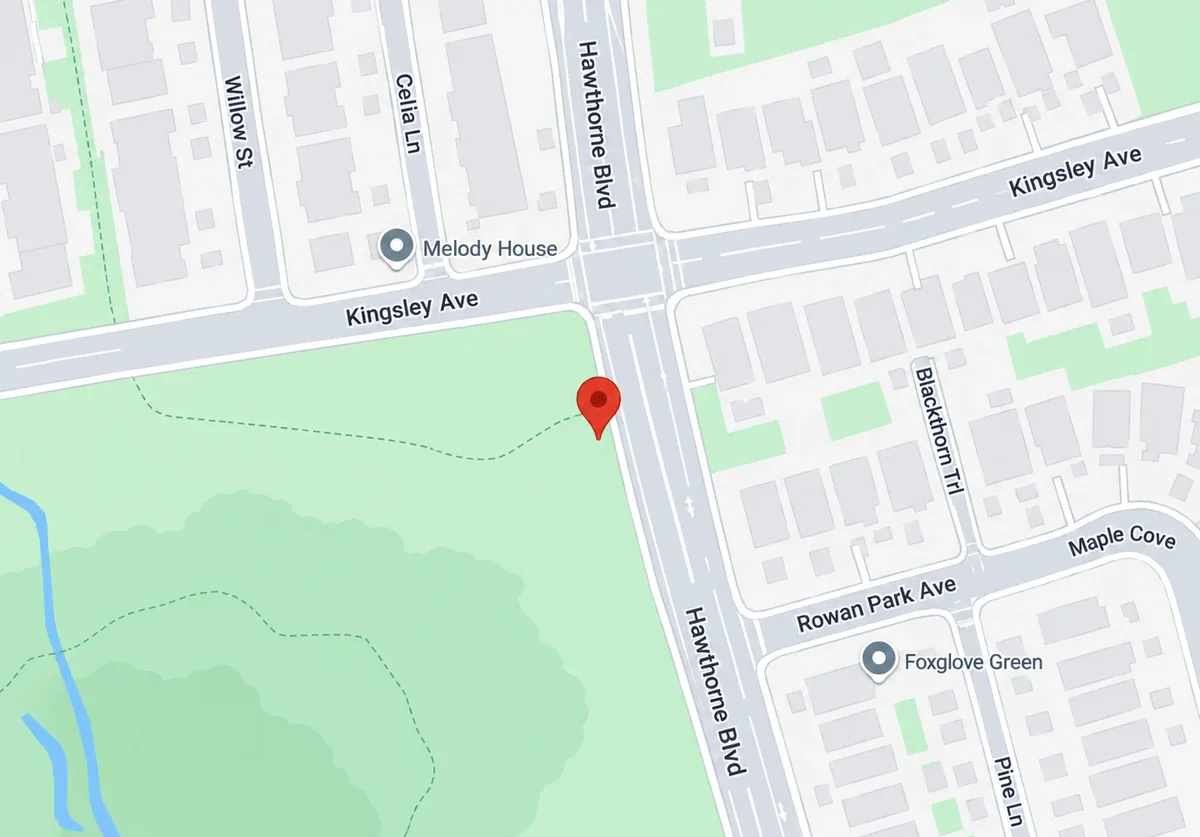
The site is the southwest corner of Kingsley Avenue and Hawthorne Boulevard, a signalized intersection, in the Rowan Park community.
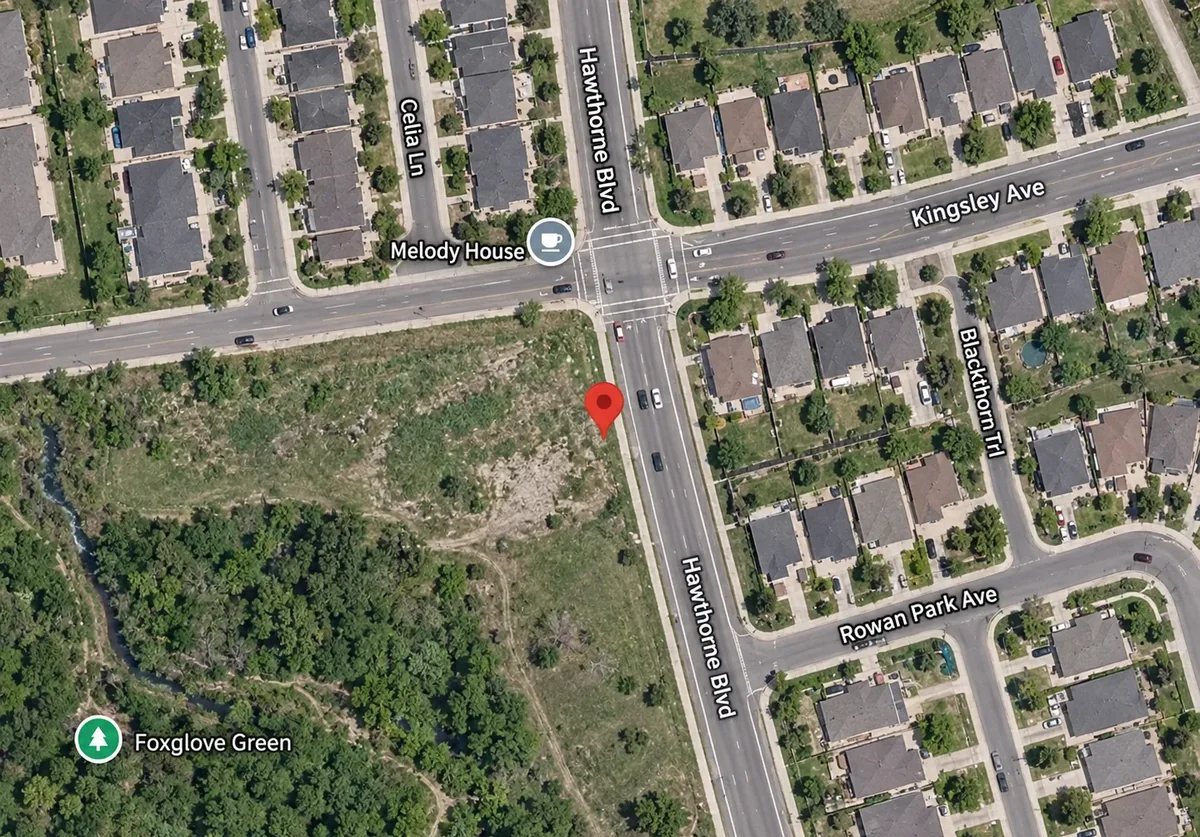
Built three-storey townhouse rows face the site across Kingsley. A detached subdivision lies east across Hawthorne, and the wooded Foxglove Green valley lies about 150 m southwest.
Zoning compliance at a glance
| Standard | Required | Proposed | Result |
|---|---|---|---|
| Lot frontage, front-lane unit | 6.0 m | 4.71 m | Relief sought |
| Lot frontage, rear-lane unit | 7.0 m | 5.79 m | Relief sought |
| Rear yard, west boundary | 7.0 m | 6.06 m | Relief sought |
| Front yard, lane frontage | 4.0 m | 4.35 m | Complies |
| Front yard, Hawthorne | 3.0 m | 3.62 m | Complies |
| Rear yard, garage side | 1.0 m | 5.96 m | Complies |
| Interior side yard | 1.2 m | 1.55 m | Complies |
| Exterior side yard | 2.4 m | 3.23 m | Complies |
| Height, roof mid-point | 12.0 m | 10.34 m | Complies |
| Visitor parking | 2 to 4 | 0 | Deficiency |
The three reliefs are carried in the draft by-law. Visitor parking is not, on any reading. Full matrix with the arithmetic in Part II, Section 9.2.
Height by building
The by-law measures a pitched roof at the mid-point between eaves and ridge, so the peaks do not govern. Full analysis in Part II, Section 9.3.
Part I
Executive brief
A standardized, table-driven summary for rapid professional review: the proposal, status language, key matters, and nine standard checks from approvals to sources.
Summary of Proposal
The proposal seeks to redevelop five vacant registered residential lots at 5-13 Kingsley Avenue, at the southwest corner of Kingsley Avenue and Hawthorne Boulevard in the Rowan Park community, with 16 three-storey townhouse units in three buildings: an east row of 7 rear-lane townhouses fronting Hawthorne Boulevard, and a west row of 9 front-lane townhouses in two buildings of 5 and 4 units, arranged around a north-south private internal lane with a single vehicular access from Kingsley Avenue. The applications comprise a Zoning By-law Amendment from R2-3 to a site-specific R4 exception and Site Plan Approval, with a future common element condominium anticipated for the private road and shared infrastructure. The five lots were approved for single-detached dwellings within Phase 2 of the registered Rowanfield plan of subdivision and are vacant, graded, and fully serviced.
Standard Status Language
Every status in this report is expressed in two parts, using the standardized vocabulary below. The Verification status describes how reliable the underlying fact is; the Assessment status states the planning conclusion.
Verification / evidence status:
| Status | Meaning |
|---|---|
| Provided and Verified | Supplied by the applicant and independently verified |
| Not Provided but Verified | Not reliably supplied, but independently established |
| Provided but Unable to Verify | Supplied but independent verification was not possible |
| Information Not Available | Necessary information could not be established |
| Not Applicable | Verification is not relevant to this item |
Planning / assessment status:
| Status | Meaning |
|---|---|
| Complies | Meets the applicable requirement |
| Generally Supportive | Policy or design framework generally supports it |
| Non-Compliant | Does not satisfy the existing requirement |
| Relief Required | Non-compliance is intended to be addressed through an approval or exception |
| Issue to Resolve | Material issue remains unresolved |
| To Confirm | Planning conclusion depends on outstanding information |
| Required | Application, action, or document is required |
| Not Required | Requirement clearly does not apply |
| Revisions Required | Current submission must be revised |
| Later Stage | Required, but not at the current approval stage |
| Not Applicable | Planning matter does not apply |
Key Matters
The main findings a professional needs in order to understand the condition of this proposal quickly. Each item states the fact, the analysis, and the consequence.
| Matter | Key Finding and Analysis | Verification | Assessment |
|---|---|---|---|
| Official Plan designation | Low Density Residential (Rowan Park Land Use Plan), which permits townhouses. An Official Plan Amendment might be required depending on how density is interpreted and calculated | Provided and Verified | Issue to Resolve |
| Current zoning | R2-3 (Residential Two, Sub-Zone Three), By-law 2023-047, on all five lots. Townhouses are not permitted under the current zone and the proposal is non-compliant with three Zoning By-law standards; relief is needed | Provided and Verified | Non-Compliant Relief Required |
| Rezoning sought | R2-3 to a site-specific R4-XX exception with three reliefs (frontages of 4.71 m and 5.79 m per unit; rear yard of 6.06 m). The draft by-law does not yet carry a visitor-parking mechanism, the Region-recommended Holding (H) provision, or yard-definition mechanics for the undivided condominium lot, so a redraft is expected | Provided and Verified | Revisions Required |
| Building height | Both rows comply with the 12.0 m maximum on the governing mid-point measure (10.17 m east row, 10.34 m west row; the 11.88 m and 12.23 m peaks do not govern). The applicant's own documents state height inconsistently (11.88 m and 12.5 m), so height should be restated on the drawings' basis | Provided and Verified | Complies |
| 4-unit building drawings | No elevation or floor-plan set was provided for the 4-unit west building; its height and garage configuration are presumed from the adjacent 5-unit building. Approval documentation should not rest on presumed drawings; the applicant should submit the set or confirm in writing that the adjacent set governs | Provided but Unable to Verify | Issue to Resolve |
| Density | About 55.2 units/ha on the 0.29 ha site and about 18 to 19 units/net ha across the wider Phase 2, against an Official Plan range of 20 to 30 units/net ha. The site-scale figure is above the range and the area-scale figure below it, so which geography the range tests determines whether an Official Plan Amendment is required | Provided and Verified | Issue to Resolve |
| Parking | 46 resident spaces are provided against 32 required, which complies. No dedicated visitor spaces are shown anywhere on the plan against a requirement of 2 to 4 depending on interpretation; a visitor solution (dedicated bays or a justified site-specific rate) is needed before approval | Provided and Verified | Issue to Resolve |
| Servicing capacity | Water is available from the existing Kingsley main, but downstream sanitary capacity is currently exceeded. Brackenridge Region recommends a Holding (H) provision so development is sequenced to servicing allocation; the (H) is not yet in the draft by-law | Provided and Verified | Issue to Resolve |
| Fire and waste access | The private lane dead-ends with no turnaround, and the applicant's own Traffic Brief accepts fire and waste trucks reversing onto Kingsley Avenue. A turnaround or the written acceptance of Fire and Engineering is needed at Site Plan Approval | Provided and Verified | Issue to Resolve |
| Environmental and source water | Outside the Greenbelt, Oak Ridges Moraine, and Niagara Escarpment plan areas. Within the Alder River watershed, a Wellhead Protection Quantity area, and a Highly Vulnerable Aquifer; ARCA treats the site as within a Significant Groundwater Recharge Area. ARCA has no objection to the rezoning but considers Site Plan Approval premature pending updated groundwater work | Provided and Verified | Issue to Resolve |
| Archaeology | Within an area of archaeological potential; a Stage 1-2 archaeological assessment is the standard expectation before site alteration and none is in the project documents | Not Provided but Verified | Required |
| Public position | Three written objections are on record (height and shadowing, parkette adjacency, traffic, property values) and the statutory public meeting was held June 23, 2026. The height and overlook concerns interact with the west-boundary transition, a live site plan design item | Provided and Verified | To Confirm |
What Works Well and Issues to Resolve
| What Works Well | Issues to Resolve |
|---|---|
| Townhouses are permitted by the Low Density Residential designation | The Official Plan density interpretation remains unresolved |
| Provincial and Regional policy generally support intensification on this serviced settlement-area site | Downstream sanitary capacity requires a Holding (H) provision and a servicing allocation |
| Existing three-storey townhouses immediately north provide a strong local precedent | No dedicated visitor parking is shown on the plan |
| Governing building heights comply with the Zoning By-law by a comfortable margin | The fire and waste turnaround condition is unresolved |
| Resident parking exceeds the minimum (46 spaces against 32 required) | Updated groundwater and hydrogeological work is required |
| Public-street orientation is strong: the east row fronts Hawthorne with garages hidden on the lane side | The west boundary transition and privacy interface requires site plan design attention |
1Approval Requirements
A standardized view of every approval and decision this proposal could engage, including those that do not apply.
| Approval / Decision | Finding | Status |
|---|---|---|
| Official Plan Amendment | Whether an amendment is required depends on the Town's position on how the Official Plan density range is applied (Part II, Section 8.3) | To Confirm |
| Zoning By-law Amendment | Required to permit townhouses and site-specific standards; under review | Required |
| Minor Variance | Not the proposed approval route; relief is carried through the Zoning By-law Amendment | Not Applicable |
| Site Plan Approval | Required (16 units exceeds the 10-unit exemption); under review; the current package requires further revisions | Required |
| Plan of Subdivision | Not required; the five lots are already registered (Plan 65M-5123) | Not Required |
| Plan of Condominium (Common Element) | A common element condominium is anticipated to hold the private lane and shared services; a required future application | Later Stage |
| Consent / Severance / Part Lot Control | The tenure concept requires each townhouse to be a freehold parcel tied to the common element lane; the mechanism for creating the 16 townhouse parcels from the five registered lots should be confirmed with the future condominium stream | To Confirm |
| Temporary Use By-law | No temporary use is proposed | Not Required |
| Holding Provision / Removal | Brackenridge Region recommends a Holding (H) provision for sanitary capacity; if enacted, a future removal application follows once allocation is confirmed | Later Stage |
| Heritage Permit Application | No listed or designated heritage property is identified on or abutting the site; the Rowan Mills Heritage Conservation District boundary should be confirmed | Not Required To Confirm |
2Property & Proposal Snapshot
A standardized summary of the site, current proposal, tenure, and application record.
| PROPERTY | UNITS / FORM | ZONING PATH | APPROVALS |
|---|---|---|---|
| 5-13 Kingsley Avenue, Rowan Park, Town of Linden Vale (Lots 31-35, Plan 65M-5123, Part of Lot 14, Concession 3) | 16 three-storey townhouses (7 rear-lane, 9 front-lane) on 0.29 ha | R2-3 to site-specific R4-XX | Zoning By-law Amendment and Site Plan Approval; a Plan of Condominium (common element) will follow |
| Item | Current Proposal |
|---|---|
| Municipality | Town of Linden Vale |
| Upper-tier / Region | Regional Municipality of Brackenridge |
| Community | Rowan Park |
| Site / affected area | Five contiguous vacant registered lots, about 0.29 ha (0.72 ac) |
| Legal description | Lots 31-35, Registered Plan 65M-5123, Part of Lot 14, Concession 3 |
| Municipal addresses | 5, 7, 9, 11 and 13 Kingsley Avenue |
| Current use | Vacant, graded land within a substantially built-out phase of a registered subdivision |
| Proposed use | 16 three-storey townhouse dwellings |
| Building composition | East row: 7 rear-lane townhouses fronting Hawthorne Boulevard, integral 2-car garages off the internal lane. West row: 9 front-lane townhouses in two buildings (5 and 4 units), integral 1-car garages facing the lane |
| Site area / density | 0.29 ha; about 55.2 units/ha at the site scale |
| Current zoning | R2-3 (By-law 2023-047) |
| Proposed zoning | Site-specific R4-XX exception |
| Tenure | Common element condominium: each townhouse a freehold parcel, with the private internal lane and shared services held as common elements |
| Applications | Zoning By-law Amendment and Site Plan Approval; a future Plan of Condominium (common element) |
| Owner / Applicant | Rowanfield Estates Inc. (Northbank Homes group) |
| Planning consultant | Calder Planning Partners Inc. |
| Application status | Deemed complete April 8, 2026; circulated March 27, 2026; statutory public meeting held June 23, 2026 |
| Public record | Three written objections on file |
Sources: Site Plan; Planning Justification Report; Draft Zoning By-law Amendment text and schedule; application forms; registered-plan material; Brackenridge Region GIS and Town zoning mapping.
3Policy & Official Plan
A standardized review of every senior planning instrument, each with its own row, verification status, and planning assessment. The detailed policy-by-policy analysis is in Part II, Sections 7 and 8.
| Planning Instrument | Key Finding / Analysis | Verification | Assessment |
|---|---|---|---|
| Planning Act, R.S.O. 1990, c. P.13 | The ZBA (s. 34) and SPA (s. 41) are the appropriate statutory streams; s. 36 provides the authority for the recommended Holding provision, and s. 3 makes the PPS a consistency test and the provincial and Regional plans a conformity test for Council's decision | Not Provided but Verified | Generally Supportive |
| Provincial Planning Statement 2024 | Supports settlement-area intensification, housing mix, and efficient use of land and infrastructure; the live consistency test is servicing availability, managed by the Holding-and-allocation mechanism, with source-water work outstanding at Site Plan Approval | Not Provided but Verified | Generally Supportive |
| Greenbelt Plan 2017 | The site is outside the Greenbelt Area; no Greenbelt policy is engaged | Not Provided but Verified | Not Applicable |
| Niagara Escarpment Plan 2017 | The site is outside the Niagara Escarpment Plan Area; no NEP policy is engaged | Not Provided but Verified | Not Applicable |
| Oak Ridges Moraine Conservation Plan 2017 | The site is outside the Oak Ridges Moraine Area; the applicable groundwater regime is the source-water framework, not moraine policy | Not Provided but Verified | Not Applicable |
| Brackenridge Region Official Plan (2022, June 2024 consolidation) | Compact Community-Area intensification on existing services conforms in principle; the operative conformity test is servicing capacity and phasing, resolved through the Holding provision and the allocation process | Not Provided but Verified | Issue to Resolve |
| Town of Linden Vale Official Plan (2012) | Low Density Residential permits townhouses and infill is expressly encouraged; the density-geography interpretation determines whether an Official Plan Amendment is required | Provided and Verified | Issue to Resolve |
| Rowan Park Secondary Plan / area-specific policies | The site is within the Rowan Park Secondary Plan Area on the Rowan Park Land Use Plan; the framework supports a diverse housing mix, and the detailed watershed key-feature policies expressly do not apply within the Rowan Park Secondary Plan Area | Not Provided but Verified | Generally Supportive |
| Alder River / source water framework | Within the Alder River watershed, a Wellhead Protection Quantity area, and a Highly Vulnerable Aquifer; updated groundwater, infiltration, and water-balance work is required for Site Plan Approval | Provided and Verified | Issue to Resolve |
| Zoning By-law 2019-061 | Townhouses are not permitted in the current R2-3 zone and three standards require relief; the draft amending by-law needs additions (visitor parking, Holding provision, yard mechanics) | Provided and Verified | Non-Compliant Relief Required |
| Condominium Act, 1998 | The statutory framework for the future common element condominium; it confirms the freehold-townhouse-plus-common-lane tenure and re-applies the servicing-adequacy criteria at the condominium stage | Not Provided but Verified | Later Stage |
Density is the central Official Plan question. The proposal reads at about 55.2 units/ha on the 0.29 ha site and at about 18 to 19 units/net ha across the wider Phase 2, against an Official Plan range of 20 to 30 units/net ha for the designation. At the site scale the proposal is above the range; at the area scale it remains below it. The Town has not yet taken a position on which geography the range tests, and whether an Official Plan Amendment (or a documented Council interpretation) is required flows from that decision (Part II, Section 8.3).
Across every instrument, the operative approval test is servicing: water is available, but downstream sanitary capacity is exceeded, and the provincial, Regional, and local frameworks all resolve this the same way, by sequencing development to servicing allocation through the recommended Holding (H) provision.
The screened-out provincial plans (Greenbelt, Niagara Escarpment, Oak Ridges Moraine) each receive a dedicated analysis in Part II (Sections 7.3 to 7.5).
Sources: Provincial Planning Statement 2024; Brackenridge Region Official Plan; Town of Linden Vale Official Plan (2012, as amended) and schedules; Planning Justification Report; Planning Act; Condominium Act, 1998.
4Zoning & Permissions
| CURRENT ZONE | PROPOSED ZONE | ZONING PATH | KEY ZONING ISSUE |
|---|---|---|---|
| R2-3 (By-law 2023-047) | Site-specific R4-XX exception | Zoning By-law Amendment | Visitor parking and the Holding (H) provision are not yet in the draft by-law |
Zoning compliance at a glance:
| Standard | Required | Proposed | Result | Action |
|---|---|---|---|---|
| Lot frontage, front-lane townhouse | 6.0 m per unit | 4.71 m | Non-Compliant Relief Required | Covered by draft by-law relief (4.71 m) |
| Lot frontage, rear-lane townhouse | 7.0 m per unit | 5.79 m (5.94 to 6.25 m end units) | Non-Compliant Relief Required | Covered by draft by-law relief (5.79 m) |
| Rear yard (west boundary) | 7.0 m | 6.06 m north building; 7.14 m south building | Non-Compliant Relief Required | Covered by draft by-law relief (6.06 m) |
| Front yard, front-lane (to the lane) | 4.0 m (6.0 m to garage face) | 4.35 m; garage face 6.05 to 6.21 m | Complies | Confirm yard-definition mechanics in the by-law redraft |
| Front yard, rear-lane (to Hawthorne) | 3.0 m | 3.62 m minimum | Complies | Verify one 2.06 m dimension's subject on the finalized plan |
| Interior side yard | 1.2 m end unit | 2.06 m and 1.55 m | Complies | None |
| Exterior side yard | 2.4 m | 3.23 to 4.15 m | Complies | None |
| Maximum height | 12.0 m (mid-point measure) | 10.17 m east row; 10.34 m west row | Complies | Restate height consistently; provide the 4-unit building's own drawings |
| Resident parking | 32 spaces (2 per unit) | 46 spaces | Complies | None |
| Visitor parking | 2 to 4 spaces (interpretation-dependent) | 0 dedicated spaces | Non-Compliant Issue to Resolve | Add visitor bays or a justified site-specific rate in the by-law |
The current R2-3 zone permits single-detached dwellings and does not permit townhouses; townhouses (and rear-lane townhouses) are permitted only from the R4 category upward, so a rezoning to a site-specific R4 exception is required. The draft amending by-law carries exactly the three dimensional reliefs shown above; the matters the plan still needs that are not yet in the draft are a visitor-parking mechanism, the Region-recommended Holding (H) provision, yard-definition mechanics for the undivided condominium lot, and a driveway-width clarification (Part II, Sections 9.4 and 9.6). The full compliance matrix with the arithmetic is in Part II, Section 9.2.
Sources: Draft Zoning By-law Amendment text and schedule; Planning Justification Report; Site Plan; architectural elevations; Town Zoning By-law 2019-061.
5Site / Lot Configuration & Compatibility
A standardized design review of built form, public realm, transition, circulation, and day-to-day site operations. The detailed 13-category review is in Part II, Section 14.
| Design Topic | Finding | Status |
|---|---|---|
| Lot / parcel configuration | Five registered lots redeveloped as a single undivided 0.29 ha parcel; per-unit zoning standards depend on yard-definition mechanics in the by-law redraft | To Confirm |
| Built form / massing | Three-storey rows; governing heights of 10.17 m and 10.34 m sit comfortably under the 12.0 m limit, with peaks to 12.23 m | Complies |
| Streetscape / public realm | The east row fronts Hawthorne Boulevard with porches and entries to the street and garages hidden on the lane side; corner-upgrade elevations address Kingsley | Generally Supportive |
| Transition / compatibility / privacy | The three-storey form abuts existing two-storey detached homes to the west across a 6.06 to 7.14 m rear yard with a grade drop of about 2.4 m and a retaining condition; screening, fencing, and deck-overlook details need design attention | Issue to Resolve |
| Vehicular access / circulation | Single access from Kingsley, close to the signalized Hawthorne intersection, into a dead-end internal lane about 8.9 m wide, with no secondary egress and no turnaround | Issue to Resolve |
| Pedestrian / cycling connections | 1.5 m sidewalks border Kingsley and Hawthorne and the east row connects at its front doors; no internal walkway distinct from the lane is shown, while the Planning Justification Report describes one; reconcile | Revisions Required |
| Parking / loading / visitor operations | 46 resident garage and apron spaces; zero dedicated visitor bays; the "No Parking in Laneway" regime removes casual on-lane parking, so visitor demand will spill to Kingsley Avenue | Issue to Resolve |
| Landscaping / trees / buffering | A landscape plan and tree inventory are on file; Parks direction covers tree protection (including a Butternut check), street trees, boundary fencing, and sidewalk connections | To Confirm |
| Accessibility | No accessible-parking requirement applies to townhouse dwellings under the Zoning By-law; pedestrian accessibility is a site plan review item | Complies |
| Waste / snow / fire operations | No garbage facility is shown on the site plan sheet (a Waste Management Plan drawing exists and should be checked); snow storage areas are not marked; fire and waste trucks must reverse onto Kingsley absent a turnaround | Issue to Resolve |
| Lighting / utilities / signage / acoustics | Pole and bollard lighting symbols are shown but no photometric plan is provided; standard utility conditions apply; no signage schedule is provided; the extent of a 1.8 m acoustic fence needs reconciling with the front-on-Hawthorne design | Revisions Required |
| Key Design Opportunities | Key Design Risks |
|---|---|
| Correct anti-backlotting orientation: the east row fronts Hawthorne with garages hidden on the lane | West-boundary transition, privacy, and deck overlook toward the abutting detached lots |
| Like-on-like context: built three-storey townhouses directly north across Kingsley | Dead-end lane operations (fire, waste, deliveries, snow) with no turnaround |
| Comfortable height compliance on the governing By-law measure | Visitor-parking spillover onto Kingsley Avenue |
| Rear-lane garages are an expressly endorsed Official Plan parking strategy | Garage-dominant narrow front-lane facades internal to the site |
| Corner site allows upgraded flankage elevations at the Kingsley/Hawthorne intersection | A continuous acoustic fence on Hawthorne would contradict the front-on-Hawthorne design |
Sources: Site Plan; architectural drawings and elevations; Landscape Plan; Tree Inventory / Preservation material; Waste Management Plan; Accessibility Standards.
6Servicing & Technical Review
A standardized review separating true approval gates from ordinary technical comments.
| Technical Matter | Finding | Approval Impact | Status | Required Action |
|---|---|---|---|---|
| Water servicing | Water is available from the existing 200 mm Kingsley main; the hydrant flow test is pending | SPA | To Confirm | Complete the flow test confirmation |
| Sanitary capacity | Downstream capacity is currently exceeded; a servicing allocation and a conformity report under the Rowan Park Inline Storage Agreement are required | ZBA / SPA | Issue to Resolve | Add the Holding (H) provision; secure a Council-confirmed servicing allocation |
| Stormwater | Reliance on existing stormwater pond capacity requires Town confirmation; drainage pattern revisions were identified in the engineering peer review | SPA | Revisions Required | Confirm pond capacity and revise the drainage design |
| Water balance / infiltration | Water balance is not demonstrated; no groundwater data supports the infiltration trench design, and the trenches sit too close to the adjacent lot | SPA | Revisions Required | Redesign using real groundwater levels and infiltration testing |
| Hydrogeology | The 2012 hydrogeological report is outdated, with no monitoring wells on or near the property | SPA | Required | Provide an updated, ARCA-scoped hydrogeological assessment |
| Geotechnical | The 2008 soils report is too general for this design | SPA | Required | Provide a site-specific geotechnical report |
| Dewatering | No dewatering strategy is provided; the Region does not support permanent groundwater discharge to the sanitary system, and both rows have basements | SPA | Required | Provide a construction and permanent dewatering strategy |
| Fire and waste access | No turnaround exists at the dead-end lane; the Traffic Brief accepts trucks reversing onto Kingsley | SPA | Issue to Resolve | Provide a turnaround or obtain written Fire and Engineering acceptance |
The two true approval gates are sanitary capacity (which drives the Holding provision at the rezoning stage) and the groundwater and source-water package (which ARCA requires before Site Plan Approval); the remaining items are design revisions resolvable through the next submission.
Sources: Functional Servicing and Stormwater Management Report; Traffic Brief; Brackenridge Region servicing comments; ARCA comments; engineering peer review; geotechnical and hydrogeological reports.
7GIS, Environmental & Planning Constraints
A standardized screen of planning constraints, built from a comprehensive GIS screening of 763 published mapping layers and the agency record.
| Constraint / Review | Current Reading | Verification | Assessment |
|---|---|---|---|
| Conservation authority | ARCA jurisdiction; no objection to the rezoning; Site Plan Approval considered premature pending updated groundwater work | Provided and Verified | Issue to Resolve |
| Regulated area (O. Reg. 41/24) | Not within the ARCA regulation limit; no conservation-authority permit trigger at the site | Not Provided but Verified | Not Applicable |
| Source water protection | Within a Wellhead Protection Quantity area and a Highly Vulnerable Aquifer; on ARCA's written determination, within a Significant Groundwater Recharge Area | Provided and Verified | Issue to Resolve |
| Provincial plan overlays | Not within the Greenbelt, Niagara Escarpment, or Oak Ridges Moraine plan areas | Not Provided but Verified | Not Applicable |
| Natural heritage | No significant natural heritage feature on or adjacent to the site | Not Provided but Verified | Not Applicable |
| Floodplain / hazards | No floodplain or shoreline hazard identified at the site | Not Provided but Verified | Not Applicable |
| Servicing capacity | Downstream sanitary capacity exceeded; Holding (H) provision recommended | Provided and Verified | Issue to Resolve |
| Archaeological potential | Within an area of archaeological potential; a Stage 1-2 assessment is expected and none is on file | Not Provided but Verified | Required |
| Heritage register / HCD | No listed or designated property identified on or abutting the site; the Rowan Mills Heritage Conservation District boundary should be confirmed | Not Provided but Verified | To Confirm |
| Fire and emergency access | Dead-end private lane with no turnaround | Provided and Verified | Issue to Resolve |
Likely Review Team
| Reviewer | Why It Matters | Status |
|---|---|---|
| Town Planning | Lead review of the ZBA and SPA, Official Plan conformity, density interpretation | Required |
| Town Engineering / Public Works (with peer reviewer) | Servicing, stormwater, grading, traffic, fire access | Required |
| Brackenridge Region | Servicing allocation and the Holding (H) provision, Regional conformity | Required |
| ARCA | Groundwater, source water, stormwater, water balance | Required |
| Town Fire Services | Fire route, turnaround, water allocation, hydrants | Required |
| Parks / Landscape / Forestry | Tree protection, street trees, fencing, sidewalk connections | Required |
| Utilities (Bell, Rogers, Enbridge, Canada Post) | Standard easements, servicing, mail delivery | To Confirm |
| School boards (BDSB, BCDSB) | Pupil accommodation, sidewalk requests | To Confirm |
Sources: GIS screening results; circulation responses on file; Brackenridge Region, ARCA, Town Fire, and engineering peer-review comments.
8Key Issues & Recommended Actions
A prioritized action plan identifying each issue, why it matters, the recommended action, who is responsible, and the approval stage at which it lands.
| Priority | Issue | Why It Matters | Recommended Action | Responsible Party | Stage |
|---|---|---|---|---|---|
| Critical | Downstream sanitary capacity is exceeded and the Holding (H) provision is not in the draft by-law | Development cannot proceed to build-out without a confirmed servicing allocation | Add the R4-XX(H) provision with the Region's removal terms; secure the allocation and the required conformity report | Applicant / Town / Brackenridge Region | ZBA |
| High | The Official Plan density geography is unresolved (site-level above the range, area-level below it) | Determines whether an Official Plan Amendment is necessary | Document the Town's position on which geography the range tests | Town Planning | ZBA |
| High | No dedicated visitor parking is shown; the requirement is 2 to 4 spaces | The plan provides zero functional visitor spaces on every interpretation | Provide dedicated visitor bays on the plan, or write a justified site-specific visitor rate into the R4-XX exception | Applicant | ZBA / SPA |
| High | No fire and waste turnaround; the Traffic Brief accepts trucks reversing onto Kingsley | An operational and emergency-access concern that survives rezoning | Provide a turnaround within the site, or obtain Fire and Engineering's written acceptance | Applicant / Fire / Engineering | SPA |
| High | ARCA considers Site Plan Approval premature pending updated groundwater work | The source-water package is an approval gate, not a routine comment | Provide an updated, ARCA-scoped hydrogeological assessment, monitoring wells, infiltration testing, and comment matrices | Applicant / ARCA | SPA |
| Medium | The 4-unit building's drawings were not provided and the block numbering conflicts across documents | Approval documentation should not rest on presumed drawings or ambiguous building references | Submit the missing drawing set (or confirm the adjacent set governs) and reconcile the numbering | Applicant | ZBA / SPA |
| Medium | The current site plan is a concept drawing missing standard content | Site Plan Approval cannot finalize on a concept sheet | Provide a finalized site plan with the parking, standards, landscape, amenity, garbage, snow, and signage content | Applicant | SPA |
| Medium | The applicant's documents state building height and unit count inconsistently | Inconsistent figures undermine the approval record | Restate height on the drawings' basis (peak and the By-law mid-point measure per building) and reconcile the 15 versus 16 unit figure | Applicant | ZBA / SPA |
| Medium | The Kingsley access sits close to the signalized Hawthorne intersection and the Traffic Brief does not test its spacing or queue interaction | An access inside the intersection queue blocks turning traffic and adds conflicts at the busiest point on the frontage | Add an access-spacing and queue check to the Traffic Brief; restrict turns if the queue reaches the access | Applicant / Town Engineering | SPA |
Recommended decision point: The rezoning is supportable in principle once the density position is documented, the Holding (H) provision is added, and the relief set is completed. Site Plan Approval should follow a second submission that resolves the parking, fire access, groundwater, and drawing-completeness items. None of the outstanding items appears fatal on the materials reviewed.
9Sources & Important Notes
A concise professional source record.
Key Application Documents Reviewed
- Site Plan and architectural plans / elevations for the current townhouse concept.
- Planning Justification Report and the March 6, 2026 submission cover letter.
- Draft Zoning By-law Amendment text and schedule.
- Functional Servicing and Stormwater Management Report and Traffic Brief.
- Pre-consultation checklist (October 2024), OBC data matrix, and application forms.
- Landscape, planting, tree inventory / preservation, waste-management, accessibility, construction-management, and cost-estimate material.
- Geotechnical, hydrogeological, engineered-fill, registered-plan, and supporting technical documents.
Planning Instruments Reviewed
- Planning Act, R.S.O. 1990, c. P.13.
- Provincial Planning Statement, 2024.
- Greenbelt Plan 2017, Niagara Escarpment Plan 2017, and Oak Ridges Moraine Conservation Plan 2017 (screened; see Part II, Sections 7.3 to 7.5).
- Brackenridge Region Official Plan (2022, June 2024 office consolidation).
- Town of Linden Vale Official Plan (2012, as amended) and schedules.
- Town of Linden Vale Zoning By-law 2019-061 and applicable general provisions.
- Condominium Act, 1998, S.O. 1998, c. 19.
- Alder River Watershed Protection Plan and applicable source-water protection policies.
Part II
Professional planning analysis
The full analysis behind the brief: property and context, the policy framework instrument by instrument, the density test, zoning and parking with the arithmetic, site plan control, agency positions, urban design, questions, and the overall assessment.
1Proposal
Rowanfield Estates Inc. proposes to rezone five vacant registered lots (Lots 31-35, Plan 65M-5123, municipally 5-13 Kingsley Avenue) from R2-3 to a site-specific R4-XX zone and to obtain site plan approval for 16 three-storey townhouse dwellings on a 0.29 ha site at the southwest corner of Kingsley Avenue and Hawthorne Boulevard in Rowan Park. The proposal replaces 5 approved single-detached lots within Phase 2 of the registered Rowanfield plan of subdivision (19T-11006, Plan 65M-5123, registered 2017).
The 16 units sit in two rows flanking a north-south internal private road with a single vehicular access from Kingsley Avenue: an east row of 7 rear-lane townhouses fronting Hawthorne Boulevard with integral 2-car garages accessed from the lane, and a west row of 9 front-lane townhouses (in two buildings of 5 and 4) fronting the lane with integral 1-car garages. The project is intended to proceed as a common element condominium for the shared lane, which will require a future Plan of Condominium application.
Application streams: ZBA (required; the proposal is not permitted in R2-3) and SPA (required; more than 10 residential units). A Plan of Condominium (common element) is a required future stream. See Sections 5, 9, and 10.
1.1 Building Identity Summary
The applicant's documents number the three townhouse buildings inconsistently, so this report identifies each building by its unit type and physical side rather than by any one source's block number. The summary below resolves the physical buildings; it deliberately does not adopt any source's block numbers, because the numbering conflicts across sources.
| Physical row (as referenced in this report) | Architectural set label | PJR narrative label | Unit-type code (as written) | Unit width | Unit count | Garage configuration | Source drawings |
|---|---|---|---|---|---|---|---|
| East row, rear-lane towns, fronting Hawthorne Blvd | "BLOCK 1" (title block, model: BLOCK 1) | "Block '3' - 7 rear lane townhouse units" | RLTH-01, RLTH-02 (elevation keys); "3 STRY RL TOWNS", "19FT - 3 STOREY 1900 SQ.FT INT. RL TOWNS TYPE 1" | 5.79 m interior units (19'-0''); 5.94 m / 6.25 m end units (19'-6'', 20'-6'') | 7 (sums with west row to stats-table 16) | 2-car integral garage at rear (lane side): "GARAGE 18'-2'' x 20'-0''" interior units, 18'-4'' ends, on the ground floor plan; one double door per unit on the rear elevation | Block 1 elevation set and floor plan / roof set (January 19, 2026: front and rear elevations with 7 unit keys; ground floor garage labels; 135'-0'' (41.15 m) block length; roof plan); site plan typical "RL TOWNS TYPE 1" |
| West row, north building, front-lane towns, at the Kingsley corner | "BLOCK 3" (title block, model: BLOCK 3) | "Block '1' - 5 front lane townhouse units" | FL-TH-15-1, FL-TH-15-1-MOD, FL-TH-15-2 (corner); "3 STRY FL TOWNS", "15FT - 3 STOREY 1850 SQ.FT INT. FL TOWNS TYPE 2" | 4.71 m interior (PJR: front-lane frontages 4.71 to 5.31 m; the 15-ft product name implies a nominal 4.57 m; the typical is dimensioned 4.71 m) | 5 | 1-car integral garage at front (lane side): "GARAGE 10'-0'' x 20'-0''" on the ground floor plan; one single door per unit on the front elevation | Block 3 elevation set and floor plan / roof set (January 19, 2026: front, rear, flankage, and side elevations with 5 unit keys including the corner unit; ground floor; roof plan); site plan typical "FL TOWNS TYPE 2" |
| West row, south building, front-lane towns | NO ARCHITECTURAL SET ON FILE | "Block '2' - 4 front lane townhouse units" | Presumed FL-TH-15 series (unverified) | Presumed 4.71 m (unverified) | 4 | Presumed 1-car integral garage (unverified against its own sheets) | No drawing set was provided in the project documents. Presumptions carried from the adjacent 5-unit building's set and the site plan typicals only |
Sum check: 7 + 5 + 4 = 16, matching the site plan statistics total.
Numbering conflict: the architectural sets and the PJR narrative use OPPOSITE numbers for the same physical buildings (architectural "BLOCK 1" is the PJR's "Block 3", and architectural "BLOCK 3" is the PJR's "Block 1"), and no drawing set exists for the PJR's "Block 2". The site plan itself uses no block numbers at all (it labels rows by product: "RL TOWNS 7 UNITS", "3 STRY FL TOWNS"). No source's numbering is adopted as fact anywhere in this report; every claim is cited by unit type plus physical side. Question for the applicant: reconcile the block numbering across the architectural sets, the PJR, and the OBC matrix, and submit the missing 4-unit building set (Section 17, Q-A1, Q-A2).
2Description of Subject Property and Existing Uses
The site comprises five contiguous vacant registered lots totalling 0.29 ha (0.72 ac) at the southwest corner of Kingsley Avenue and Hawthorne Boulevard in the Rowan Park community. Per-parcel identity:
| Address | PIN | Plan | Zoning (GIS) |
|---|---|---|---|
| 5 Kingsley Avenue | 041870213 | 65M-5123 | R2-3 (By-law 2023-047) |
| 7 Kingsley Avenue | 041870214 | 65M-5123 | R2-3 (By-law 2023-047) |
| 9 Kingsley Avenue | 041870215 | 65M-5123 | R2-3 (By-law 2023-047) |
| 11 Kingsley Avenue | 041870216 | 65M-5123 | R2-3 (By-law 2023-047) |
| 13 Kingsley Avenue | 041870217 | 65M-5123 | R2-3 (By-law 2023-047) |
The lots are graded, vacant, and were part of an engineered fill program (an engineered fill lot plan and certification letter are in the submission set). Registered legal description is Lots 31-35, Plan 65M-5123; the "Lots 12-16" numbering that appears in older documents (the 2017 Regional DC clearance, Town Finance comments) is the original draft-plan numbering for the same lands. Grade falls roughly 2.4 m from east to west across the site; the west boundary interface includes retaining and grade transition against the abutting lots.
Existing use: vacant land within a registered, substantially built-out phase of an approved subdivision. The five lots are the only undeveloped lots on this frontage apart from the separate future development block to the south.
3Surrounding Context and Neighbourhood Character
Orientation basis: the site plan's north indicator shows north to the top of the sheet; Kingsley Avenue runs along the north edge and Hawthorne Boulevard along the east edge. This mapping is cross-checked against the Town location map and the GIS coordinate geometry.
Adjacency, each relationship verified against current imagery and plan records:
- North (across Kingsley Avenue): built three-storey townhouse rows on Willow Street and Celia Lane, within the Phase 3 plan (65M-5240, registered 2020, a separate plan north of Kingsley). These are the nearest sensitive receptors; one of the three objectors resides at 4 Willow Street.
- East (across Hawthorne Boulevard): built low-rise detached subdivision (Blackthorn Trail, Rowan Park Avenue, and Maple Cove).
- South: the vacant Phase 2 future development block (Block 52) and open lands. This land is NOT built and is NOT occupied; no claim of existing homes to the south is supportable.
- West (abutting): registered single-detached lots on Kingsley Avenue, developed with dwellings per the registered plan and building permit record; the site plan labels the abutting lots as Lots 28, 29, 30.
- Northeast corner context: Kingsley Avenue meets Hawthorne Boulevard at a signalized intersection immediately northeast of the site, and a bus platform provision is labelled at the site's northeast corner ("BUS PLATFORM PER BT-1.01"). The single site access on Kingsley therefore sits close to a signalized approach; its spacing from the stop bar and the eastbound queue is a check the Traffic Brief does not yet make (Section 17, Q-G5).
Neighbourhood trajectory: an actively completing greenfield community. Prevailing built form is two-storey detached on the streets west of the site and east of Hawthorne, with the Phase 3 townhouse rows immediately north establishing a three-storey attached precedent directly across the street from the site. A parkette and school/park block sit within walking distance to the northwest per the Official Plan schedule, and the wooded Foxglove Green valley, with its watercourse and trail network, lies roughly 150 m to the southwest.
Transit: the site plan labels a Brackenridge Transit bus platform provision at Hawthorne/Kingsley, while the GIS screening returned no existing stop or route match at the point. These reconcile as a planned platform provision built to a Brackenridge Transit standard, not evidence of existing service: transit provision is planned for at the frontage, but the site is not transit-served today.
Infrastructure scan: no railway corridor and no transmission corridor is visible within the immediate area on current aerial imagery or the location map; no railway-setback or crash-wall trigger identified. Pipelines cannot be excluded from imagery; none is flagged in any circulation response on file.
4Description of Applicant, Land Owner, and Consultants
- Owner/Applicant: Rowanfield Estates Inc. (Northbank Homes group)
- Planning consultant (agent): Calder Planning Partners Inc. (principal planner; senior planner as the primary contact; planning associate)
- Developer contact: Northbank Homes (development manager and two project leads)
- Architect/designer: Fernhill Design Studio (site plan and architectural sets; "Tessera Architecture" appears on the title blocks)
- Civil engineering: Tarnbrook Consulting Engineers (FSR/SWM, cost estimate)
- Landscape: Greenline Landscape Architects (landscape drawing set); tree inventory by Birchmark Arboriculture Inc.
- Traffic: Traffic Brief author as identified in the engineering peer-review record
- Surveyor: Meridian Survey Associates Ltd. (M-plans)
5Anticipated Application Requirements
- ZBA (this application): required because R2-3 permits single-detached dwellings and does not permit townhouse dwellings; both "Dwelling, townhouse" and "Dwelling, townhouse with rear lane access" are permitted uses only from R4 upward (Zoning By-law Table 7A).
- SPA (this application): required; 16 units exceeds the 10-unit Bill 23 exemption threshold (Section 10).
- Plan of Condominium (Common Element), future: required to hold the private internal road and shared services; also the condition on which the "Townhouse dwelling with rear lane access, subject to a Plan of Condominium" parking row rests (Section 9.4).
- Holding (H) removal process, future: if the Town adopts Brackenridge Region's recommended R4-XX(H), an H-removal application will follow once servicing allocation is confirmed (Section 12.1).
- Supporting studies already submitted are listed in the application record; the outstanding-materials list for SPA finalization is in Section 11.2.
6GIS Analysis
Source: a comprehensive GIS screening of this property run September 11, 2026 across 763 published mapping layers (Town of Linden Vale, Brackenridge Region, Ontario provincial, and conservation authority services; 515 point-queryable; 107 matched at the site; query point at the centroid of 5 Kingsley Avenue).
Matched planning essentials:
- Municipality/Ward: Town of Linden Vale, Ward 3
- Zoning: R2-3, By-law 2023-047, uniform across all five parcels (Town-hosted zoning service)
- Lot/Concession: Concession 3, part of Lot 14 (Regional parcel layer)
- Archaeological potential: matched ("Final Archaeological Potential", Regional heritage layer); triggers Stage 1-2 AA expectations (Section 15)
- Watershed/CA: Alder River Conservation Authority; quaternary watershed 04KD-07 (Alder River East Branch system); within the Alder River Watershed Protection Plan area
- Source water: within a Source Protection Area; WHPA-Q1/Q2 (RISKLEVEL=Moderate, Regional Tier 3 water budget); Highly Vulnerable Aquifer (conservation authority HVA layer, HVAID=4)
- O. Reg. 41/24 regulation limit (ARCA authoritative layer): NOT matched; no CA permit trigger at the point; the nearest regulated feature is the Foxglove Green valley about 150 m southwest; consistent with ARCA's written comments
- Floodplain / shoreline hazard: not matched
- SGRA: the ARCA and Regional SGRA layers return no match at the parcel (including a 100 m buffer), but ARCA's 2026-04-27 written determination states the site IS within an SGRA. The written determination governs; this report treats the site as within a Significant Groundwater Recharge Area and flags the mapping discrepancy for awareness
- Provincial overlays: Greenbelt, ORM, Niagara Escarpment, provincial NHS: not matched
7Provincial and Regional Policy Framework
This section tests the subject ZBA and SPA against every senior planning instrument that could reach the site, with one dedicated subsection per instrument at the depth of the Official Plan analysis in Section 8. Four instruments apply and are analysed policy by policy: the Planning Act (7.1), the Provincial Planning Statement 2024 (7.2), the Brackenridge Region Official Plan (7.6), and the Condominium Act 1998 (7.7, as the statutory framework for the future common-element condominium). Three provincial plans are screened out on documented spatial grounds and each still receives its own subsection stating the screen and its basis: the Greenbelt Plan 2017 (7.3), the Niagara Escarpment Plan 2017 (7.4), and the Oak Ridges Moraine Conservation Plan 2017 (7.5). The Alder River Watershed Protection Plan also applies (the site is within the Alder River watershed and the protection plan area); its policy analysis is carried in the Official Plan natural-heritage and water sections (Section 8, s. 5.7 and s. 7.5) and in the site-specific servicing and groundwater concerns (Section 12.3), and is cross-referenced here rather than duplicated. Every policy or section number below was read directly from the instrument text; the applicability conclusion after each policy is analytical. Spatial screening rests on the GIS screening (Section 6), whose provincial-overlay queries returned no match for Greenbelt, Oak Ridges Moraine, Niagara Escarpment, or provincial Natural Heritage System at the parcel centroid.
| Instrument | Applies to the site? | Basis |
|---|---|---|
| Planning Act, R.S.O. 1990, c. P.13 | Applies (statutory framework) | The ZBA is a s. 34 instrument, the recommended holding is s. 36, site plan control is s. 41, and s. 3 makes the PPS and provincial plans a consistency and conformity test |
| Provincial Planning Statement 2024 | Applies (province-wide) | PPS applies to all land in Ontario; Planning Act s. 3(5)(a) requires consistency; reviewed policy by policy |
| Greenbelt Plan 2017 | Does not apply (screened out) | Applies only within the Greenbelt Area on Schedule 1; GIS screening returns no Greenbelt match at the parcel; site is a registered urban lot in the Rowan Park settlement area |
| Niagara Escarpment Plan 2017 | Does not apply (screened out) | Applies only within the Niagara Escarpment Plan Area; the escarpment corridor is well west of the site; GIS screening returns no NEP match |
| Oak Ridges Moraine Conservation Plan 2017 | Does not apply (screened out) | Applies only within the Oak Ridges Moraine Area (O. Reg. 140/02); the mapped moraine boundary is south of the site; GIS screening returns no ORM match (including a 100 m buffer) |
| Brackenridge Region Official Plan (2022, June 2024 office consolidation) | Applies (upper-tier) | Upper-tier plan; Planning Act s. 3(5)(b) requires conformity; site is within the Urban Area / a Community Area designation; reviewed policy by policy |
| Condominium Act, 1998 (S.O. 1998, c. 19) | Applies (future stream, statutory framework) | Governs the intended common-element condominium for the shared private lane (Sections 1, 5); Part X (ss. 138 to 144) creates the common elements condominium corporation and s. 9 imports Planning Act ss. 51, 51.1, 51.2 for draft-plan-of-condominium approval |
7.1 Planning Act (R.S.O. 1990, c. P.13)
Source: the current consolidation of the Planning Act, corroborated where relevant against the Ontario e-Laws consolidation (ontario.ca/laws/statute/90p13). The two townhouse applications and the future common-element condominium engage the following sections.
- s. 2 (matters of provincial interest): requires the Minister, municipal councils, local boards, planning boards, and the Tribunal, in carrying out their responsibilities, to have regard to matters of provincial interest, including (f) the adequate provision and efficient use of sewage and water services, (h) the orderly development of safe and healthy communities, (j) the adequate provision of a full range of housing including affordable housing, (p) the appropriate location of growth and development, (q) development that supports public transit and is oriented to pedestrians, and (r) well-designed built form. The proposal advances several of these interests (a fuller range of housing by adding townhouses to a detached-dominated phase, appropriate location of growth as infill on serviced land), while s. 2(f), the efficient use of sewage and water services, is the interest engaged by the downstream sanitary constraint; the recommended holding provision is how Council keeps regard to that interest.
- s. 3 (policy statements and provincial plans): s. 3(5) provides that a decision of a council or the Tribunal affecting a planning matter shall be consistent with the policy statements in effect (the PPS 2024) and shall conform with the provincial plans in effect, or shall not conflict with them. This is the statutory hook that makes the PPS 2024 (Section 7.2) a consistency test for Council's decision on this ZBA and SPA, and the Brackenridge ROP and any applicable provincial plan (Section 7.6 and the screening in 7.3 to 7.5) a conformity test.
- s. 34 (zoning by-law amendment, the primary instrument): s. 34(1) authorises local councils to pass zoning by-laws prohibiting and regulating the use of land and the height, bulk, location, size, floor area, spacing, and character of buildings, the minimum frontage and depth of parcels, and (paragraph 6) parking and loading facilities. The requested R2-3 to R4-XX amendment is a s. 34 instrument; the frontage and rear-yard reliefs and the parking questions in Section 9 are all s. 34(1) matters. The recent s. 34(1.1) parking-minimum restrictions apply only within protected major transit station areas and Official-Plan-delineated higher-order transit areas, neither of which captures this site, so they do not constrain the visitor-parking analysis.
- s. 36 (holding by-law, which Brackenridge Region recommends): s. 36(1) lets a council, in a by-law passed under s. 34, use the holding symbol "H" in conjunction with a use designation to specify the future use to which lands may be put once the symbol is removed by amendment; s. 36(2) requires an official plan in effect containing provisions relating to the holding symbol; and s. 36(3) sets the removal-appeal mechanism. This is the statutory authority for Brackenridge Region's recommended R4-XX(H); Official Plan s. 8.9 supplies the required holding provisions (Section 8). The draft ZBLA currently contains no holding symbol (Section 9.6).
- s. 41 (site plan control, more than 10 units): s. 41(1.2) exempts residential development on a parcel that will contain no more than 10 residential units from the definition of development. At 16 units the proposal exceeds the 10-unit exemption, so site plan control applies, confirming Section 10. s. 41(4) governs the plans and drawings the municipality may require; s. 41(7) lets the municipality require, as a condition of approval, works such as road widenings, access, parking, landscaping, lighting, and grading; and s. 41(6) provides that nothing in the section confers power to limit the height or density of buildings, which are s. 34 matters. This frames the SPA-stage requirements in Section 11.2 and confirms that massing and density are carried by the zoning stream, not site plan control.
- s. 51 (approval of plans of subdivision, and the condominium context): s. 51(5) makes an upper-tier municipality with planning responsibilities the approval authority for plans of subdivision; s. 51(24) lists the criteria the approval authority shall have regard to, including (a) the effect on provincial interests under s. 2, (b) whether the plan is premature or in the public interest, (c) conformity to the official plan and adjacent plans of subdivision, (h) conservation of natural resources and flood control, and (i) the adequacy of utilities and municipal services. The five subject lots are already registered (Plan 65M-5123), so no new plan of subdivision is proposed; s. 51 is relevant as the framework for the future common-element condominium, whose approval applies the s. 51 criteria. The s. 51(24)(i) adequacy-of-services and s. 51(24)(b) prematurity criteria mirror exactly the servicing-capacity issue driving the holding recommendation.
- Condominium linkage note: the intended common-element condominium for the shared private lane will proceed under the Condominium Act, 1998 (a future stream, Section 5), which imports the Planning Act s. 51 approval procedures and criteria for plans of condominium. The Act is analysed in Section 7.7; the s. 51 criteria above are the applicable substance.
7.2 Provincial Planning Statement 2024
The PPS 2024 applies province-wide and, under Planning Act s. 3(5)(a), Council's decision must be consistent with it. Source: the Provincial Planning Statement 2024, reviewed policy by policy. The proposal is residential intensification of vacant, serviced land inside a settlement area, so the people-and-homes, housing, settlement-area, infrastructure, water, and heritage policies are engaged.
- 2.1.4: planning authorities shall maintain at all times the ability to accommodate residential growth for a minimum of 15 years through designated and available land, and maintain at least a three-year supply of residential units on suitably zoned land, including units in draft-approved or registered plans. Rezoning these registered lots to a higher-yield townhouse form keeps servicing-ready land in the near-term supply; supportive.
- 2.1.6: planning authorities should support the achievement of complete communities by accommodating an appropriate range and mix of land uses and housing options. Adding a townhouse product to a detached-and-semi phase advances the housing-mix limb of complete communities.
- 2.2.1: planning authorities shall provide for an appropriate range and mix of housing options and densities by permitting and facilitating all types of residential intensification, including new housing options within previously developed areas and redevelopment that results in a net increase in residential units, and by promoting densities that efficiently use land, infrastructure, and public service facilities. Directly on point: the proposal is intensification within a previously developed area, with a net increase from 5 lots to 16 units, that efficiently uses existing services. The affordable-housing limb (2.2.1(a)) operates at the municipal target and strategy level and is not a site-specific requirement on this application.
- 2.3.1.1: settlement areas shall be the focus of growth and development. The site is within the Rowan Park settlement area, so the proposal directs growth where the PPS requires.
- 2.3.1.2: land use patterns within settlement areas should be based on densities and a mix of land uses that efficiently use land and resources, optimise existing and planned infrastructure and public service facilities, and support active transportation. Townhouse infill on serviced land optimises existing infrastructure; the single-access dead-end lane is the modest active-transportation qualifier (Section 14).
- 2.3.1.3: planning authorities shall support general intensification and redevelopment to achieve complete communities, including by planning for a range and mix of housing options. Supportive; the same theme as 2.2.1.
- 2.3.1.4: planning authorities shall establish and implement minimum targets for intensification and redevelopment within built-up areas. The 16 units contribute to the built-up-area intensification target if the parcel is within the mapped built boundary, the same built-boundary confirmation flagged under the Official Plan (Section 8.2, policies 3.5.2 and 3.5.3); to confirm.
- 3.1.1: infrastructure and public service facilities shall be provided in an efficient manner while accommodating projected needs, and planning for them shall be coordinated and integrated with land use planning so they are available to meet current and projected needs. The downstream sanitary-capacity constraint is precisely a 3.1.1 available-to-meet-projected-needs question; the holding provision sequences development to service availability.
- 3.6.1: planning for sewage and water services shall accommodate forecasted growth in a way that promotes the efficient use and optimisation of existing municipal services, is sustainable by the water resources on which the services rely, and protects human health and the quality and quantity of water. The proposal relies on existing municipal water and sanitary; the downstream sanitary constraint is the 3.6.1 optimisation and allocation issue, and Brackenridge Region's allocation-and-phasing approach (the holding provision) is the mechanism.
- 3.6.2: municipal sewage services and municipal water services are the preferred form of servicing for settlement areas. The site is on full municipal services, the preferred form; conforms.
- 3.6.8: planning for stormwater management shall minimise or, where possible, prevent or reduce increases in stormwater volumes and contaminant loads, minimise erosion and changes in water balance including through green infrastructure, and promote low impact development. This is the PPS basis for the stormwater, water-balance, and infiltration work ARCA and Halden require (Sections 12.2, 12.3); the on-file SWM design must meet it.
- 4.1.1 and 4.1.8: natural features and areas shall be protected for the long term, and development on lands adjacent to significant natural heritage features shall not be permitted unless an evaluation demonstrates no negative impacts. The GIS screening returns no significant natural heritage feature on or adjacent to the parcel (Section 6), so Chapter 4.1 raises no site constraint; the water and source-water policies carry the environmental analysis here.
- 4.2.1 and 4.2.2: planning authorities shall protect, improve, or restore the quality and quantity of water, using the watershed as the scale and implementing restrictions to protect municipal drinking water supplies and designated vulnerable areas; and development shall be restricted in or near sensitive ground water features so that hydrologic functions are protected, which may require mitigation or alternative approaches. The site is within a Wellhead Protection Quantity area, a Highly Vulnerable Aquifer, and, on ARCA's written determination, a Significant Groundwater Recharge Area; policy 4.2 is the PPS source-water hook for ARCA's outstanding hydrogeology, infiltration, and source-water requirements (Section 12.3).
- 4.6.2: planning authorities shall not permit development and site alteration on lands containing archaeological resources or areas of archaeological potential unless the significant archaeological resources have been conserved. The site is within an area of archaeological potential (Sections 6, 15), so 4.6.2 requires the Stage 1-2 assessment before site alteration; that assessment is not yet on file.
- 5.1.1: development shall be directed away from areas of natural or human-made hazards where there is an unacceptable risk to public health or safety or of property damage. The GIS screening returns no floodplain, shoreline, or hazard match at the point (Sections 6, 10), so Chapter 5 raises no constraint.
PPS 2024 assessment: consistent, with the single live consistency test being infrastructure and servicing (3.1.1, 3.6.1) managed by the holding-and-allocation mechanism, and the source-water work (4.2) outstanding at SPA. This mirrors the Official Plan conclusion.
7.3 Greenbelt Plan 2017 (screened out)
Instrument and area: the Greenbelt Plan was prepared and approved under the Greenbelt Act, 2005 and applies to the Greenbelt Area as shown on Schedule 1 of the Plan; the Plan includes and builds upon the lands of the Niagara Escarpment Plan and the Oak Ridges Moraine Conservation Plan together with the Protected Countryside, and identifies where urbanisation should not occur. Screening evidence: the GIS Layer Profile v2 provincial-overlay queries returned no Greenbelt match at the parcel centroid, and the subject lands are five registered urban residential lots inside the Rowan Park settlement area, not within the Protected Countryside. Conclusion: the Greenbelt Plan does not apply to the subject lands; none of its Protected Countryside, agricultural-system, or natural-system policies reach the site. Linden Vale contains Greenbelt lands elsewhere in the municipality, but not at this location. No Greenbelt Plan policy is engaged by this ZBA or SPA.
7.4 Niagara Escarpment Plan 2017 (screened out)
Instrument and area: the Niagara Escarpment Plan applies throughout the Niagara Escarpment Plan Area, the escarpment and land in its vicinity that the Plan maintains substantially as a continuous natural environment, and it takes precedence over the PPS to the extent of any conflict within that Area. Screening evidence: the Niagara Escarpment corridor lies well to the west of Brackenridge Region; the subject site is in the Rowan Park lowlands of Linden Vale, outside the NEP Area, and the GIS Layer Profile v2 returned no Niagara Escarpment match at the point. Conclusion: the Niagara Escarpment Plan does not apply to the subject lands; no NEP policy is engaged by this ZBA or SPA.
7.5 Oak Ridges Moraine Conservation Plan 2017 (screened out)
Instrument and area: the ORMCP is set out in O. Reg. 140/02 under the Oak Ridges Moraine Conservation Act, 2001, and applies to the Oak Ridges Moraine Area established by regulation; the Plan divides the Moraine into Natural Core Areas, Natural Linkage Areas, Countryside Areas, and Settlement Areas. Screening evidence: the mapped Oak Ridges Moraine boundary runs across the southern municipalities of Brackenridge Region; the subject site in Rowan Park lies well north of it, and the GIS Layer Profile v2 returned no ORM match at the parcel, including a 100 m buffer. Conclusion: the ORMCP does not apply to the subject lands. Important distinction: the site's aquifer-vulnerability status (Highly Vulnerable Aquifer, Wellhead Protection Quantity area, and the Significant Groundwater Recharge Area on ARCA's written determination) is governed by the Clean Water Act source-protection framework and the Brackenridge Region Official Plan water-resource policies (Section 7.6), not by the ORMCP; the ORMCP's own aquifer-vulnerability and significant-recharge policies apply only within the Moraine and do not reach this site. Any reference to moraine groundwater policy for this parcel would be an over-reach; the applicable groundwater regime is source-water and Official-Plan-based (Sections 7.2, 7.6, 8, 12.3).
7.6 Brackenridge Region Official Plan (2022, June 2024 office consolidation)
Brackenridge Region is the upper-tier plan authority; under Planning Act s. 3(5)(b) Council's decision must conform with the Brackenridge Region Official Plan, and under Brackenridge ROP policy 7.3.2 the more restrictive of the local and Regional policies applies. (The Province adjusted upper-tier planning responsibilities effective July 1, 2024, but the Brackenridge ROP remains the applicable upper-tier plan and the June 2024 office consolidation is the current text.) Source: the Brackenridge Region Official Plan, June 2024 office consolidation, reviewed policy by policy. The site is within the Brackenridge Region Urban Area and reads as a Community Area designation in the Rowan Park settlement lands, consistent with the Community Area treatment in Section 8 (the Regional Map 1A designation call follows the local Official Plan finding and should be confirmed against the Region's mapping). The following policies are engaged.
- 2.1.3: the Regional Structure consists of land use designations on Map 1A, including Community Areas, where residential, population-related employment, and community services are directed to accommodate concentrations of existing and future population and employment growth. The townhouse infill directs residential growth to a Community Area, the designation's stated purpose; conforms (Map 1A designation read deferred, consistent with the Section 8 finding).
- 2.1.4: the urban system includes the built-up area, based on the Provincially defined built boundary, where the minimum 50 percent intensification target applies annually. If the parcel is within the mapped built boundary, the units count toward the Region's annual intensification target; this is the same built-boundary confirmation flagged under the Official Plan (Section 8.2) and PPS 2.3.1.4; to confirm.
- 2.2.2: growth management shall be integrated so that land use, financial, and infrastructure planning achieve compact development patterns, promote complete communities, optimise investments, and minimise land consumption and servicing costs. Townhouse infill on existing services is compact development that optimises prior infrastructure investment; conforms in principle, subject to the servicing-capacity phasing below.
- 2.2.4 and 2.2.5: Regional infrastructure required to support growth shall be phased on principles that include the development of complete communities, achievement of the Plan's intensification and density targets, and enhancement of the existing water and wastewater system over extensions; and infrastructure to support growth shall be phased in a financially sustainable manner. The downstream sanitary constraint is a 2.2.4 and 2.2.5 phasing question; the recommended holding provision is the local instrument that aligns development with Regional servicing phasing.
- 2.2.11: development shall be prioritised in locations with existing Regional infrastructure capacity. This is the policy most in tension on the file: water is available from the Kingsley main but downstream sanitary capacity is currently exceeded (Section 12.1); 2.2.11 supports proceeding only where capacity exists, which is exactly why the holding provision and the servicing-allocation and SDIP conformity process are required before development.
- 2.3.1 and 2.3.2: communities shall be planned and designed as sustainable, healthy, vibrant complete communities walkable to most local amenities, using land efficiently and optimising infrastructure with a compact, mixed-use, pedestrian-friendly, and transit-supportive built form. Supportive of the compact townhouse form; the single dead-end access is the walkability qualifier (Section 14).
- 2.3.13: communities shall be designed to the highest urban design and green development standards supporting walkable neighbourhoods, including (b) complementing the character of the existing community's sense of place and (f) ensuring appropriate transition to surrounding land uses to support land use compatibility. Policy 2.3.13(f) is the Regional compatibility and transition policy that parallels Official Plan 4.4.1.6 and 3.3.4.1 (Section 8); the three-storey west row against the abutting two-storey detached lots is the transition question this policy asks, and it is a site design review item (Section 14).
- 2.3.39: to provide for a mix and range of housing options suitable for all ages, household sizes, and abilities, including affordable and purpose-built rental housing. Adding a townhouse product advances the mix-and-range objective for Rowan Park.
- 2.3.40: a minimum of 25 percent of new housing outside Regional Centres and major transit station areas shall be affordable in each local municipality. This is a municipal-scale target rather than a site-specific requirement; the ZBA and SPA do not themselves deliver an affordability commitment, and whether the Town seeks one is a policy question for the recommendation report (parallel to the affordable-housing note in Section 8.2). Flag for the Town's position, not a compliance breach on this application.
- 2.3.44: local official plans and zoning by-laws shall permit a range of housing options, unit sizes, tenure, and levels of affordability within each community. The R4-XX exception permitting townhouses advances the range-of-options direction at the by-law level.
- 3.3.6: development in the water resource system shall be designed with the goal to protect, improve, or restore ground and surface water quality and quantity and the ecological and hydrological characteristics of key hydrologic features and areas, demonstrated through master environmental servicing plans or other technical studies. This is the Regional hook for the FSR, SWM, and hydrogeology work; the outstanding updated hydrogeology and infiltration design serve this policy.
- 3.3.7: in recharge management areas, development and site alteration shall maintain pre-development recharge rates to the fullest extent possible. Consistent with ARCA's no-net-reduction-in-recharge and infiltration requirement (Section 12.3) if the site is within a mapped recharge management area; the SGRA determination points the same direction.
- 3.3.8: in significant groundwater recharge areas, highly vulnerable aquifers, and significant surface water contribution areas, best management practices are encouraged for all development proposals involving the application, storage, and handling of road salt on private roadways, parking lots, and pedestrian walkways. Directly on point given the HVA and SGRA status; the common-element private lane and the tandem aprons should carry a salt-management BMP approach (parallel to Official Plan 7.5.12, Section 8).
- 3.3.16: an application for major development within Highly Vulnerable Aquifers involving the manufacturing, handling, or storage of bulk fuel or chemicals as activities prescribed under the Clean Water Act shall be accompanied by a Contaminant Management Plan, as deemed necessary by Brackenridge Region. The residential use does not involve the prescribed bulk-fuel or chemical activities, so 3.3.16 does not trigger a Contaminant Management Plan; this is noted so the file does not over-scope the requirement. The salt-BMP encouragement in 3.3.8 is the applicable HVA measure for this proposal, not a contaminant plan.
- 3.4.17: within the Alder River watershed, an application for development or site alteration within settlement and rural settlement areas shall, among other things, seek to avoid, minimise, or mitigate impacts associated with the quality and quantity of urban run-off into receiving streams, lakes, and wetlands. This Regional watershed policy reinforces the SWM and water-balance requirements; the shoreline and vegetation-protection limbs (3.4.17(a),(b),(d)) do not apply, as the site is not on or adjacent to a watercourse or to the Alder River on the GIS screening.
- 6.2.2: the delivery and operation of Regional infrastructure required to support growth shall be phased consistently with Brackenridge Region's Water and Wastewater and Transportation Master Plans and in a manner that maintains Regional financial sustainability. This is the servicing-and-phasing policy behind Brackenridge Region's allocation and holding position.
- 6.4.3: the provision of appropriate water and wastewater infrastructure and servicing capacity shall be coordinated with plans of subdivision, plans of condominium, site plans, or any other development applications by local municipalities in order to ensure services are available prior to occupancy. This is the most directly engaged servicing policy: it requires servicing capacity be confirmed for the SPA and the future condominium so services are available before occupancy, which is exactly what the downstream sanitary constraint puts in issue and what the holding provision and the SDIP conformity report resolve (Section 12.1).
- 6.4.5: full municipal water and wastewater servicing shall be provided to accommodate growth and maintain continual service in the Urban Area. The site is served by full municipal services, the required form; conforms, subject to the capacity confirmation above.
- 6.5.3: development and site alteration proposals shall meet applicable stormwater management policies, guidelines, and best practices. This is the Regional stormwater standard the finalised SWM design must meet, alongside the Official Plan Enhanced Protection standard (s. 7.4.2, Section 8).
- 7.3.1 and 7.3.2: local official plans and comprehensive zoning by-laws shall be brought into conformity with the Plan in accordance with the Planning Act, and where local and Regional policies differ the more restrictive policies apply. The ZBA must conform to the Brackenridge ROP; where the Official Plan and the Brackenridge ROP both speak (density, servicing, water resources), 7.3.2 requires the more restrictive to govern, which the recommendation report should apply when reconciling the Official Plan density-geography question (Section 8.3) with Regional intensification policy.
Brackenridge ROP assessment: conforms in principle as Community-Area intensification on the Urban Area's existing services, with the operative conformity tests being servicing capacity and phasing (2.2.11, 6.4.3, 6.2.2), resolved through the holding provision and the allocation process, and the water-resource and source-water policies (3.3.6 to 3.3.8, 3.4.17) carried by the outstanding hydrogeology and SWM work. No Brackenridge ROP policy is a hard barrier on the evidence read; the servicing sequence is the gating item, consistent with the PPS and Official Plan conclusions.
7.7 Condominium Act, 1998 (S.O. 1998, c. 19)
Source: the current Ontario consolidation of the Condominium Act, 1998, with Part X (Common Elements Condominium Corporations, ss. 138 to 144) and the creation, ownership, corporation, operation, and Planning Act provisions reviewed in full. The Act applies to this file as the framework governing the intended common-element condominium for the shared internal private road/lane (Sections 1 and 5), which is a required future stream after the ZBA and SPA. It does not regulate the two current applications directly; no condominium exists yet, and the applicant will proceed to a plan of condominium at a later stage. The provisions below are the ones that shape what the applicant must do at that future stage and what they mean for the Town and the future townhouse owners. Where a provision's engagement depends on the future condominium actually being registered, that is noted.
- s. 6 (types of corporations): s. 6(2) lists the common elements condominium corporation as one of the four freehold condominium types, and s. 6(4) requires the declaration to state whether the corporation is freehold or leasehold and, if freehold, which freehold type it is. This confirms the tenure described in Section 1 is a recognized statutory form, and the future declaration will have to identify the corporation as a common elements condominium corporation.
- s. 138 (creation of a common elements condominium corporation): s. 138(1) lets a declarant register a declaration and description that create common elements but do not divide the land into units, s. 138(2) names the resulting corporation a common elements condominium corporation, s. 138(3) requires it to be a freehold corporation that is not a vacant land or phased corporation, and s. 138(4) applies Parts I to IX, XI and XIV with modifications so that references to a "unit" are read as references to a "common interest" in the corporation. This is the exact vehicle the proposal contemplates: the shared private lane and its services become the common elements of the corporation and there are no condominium units, which is why the site reads as 16 freehold-style townhouse parcels sharing a common-element road (Section 1).
- s. 139 (owners' land): s. 139(1) prohibits registration unless each owner of a common interest also owns the freehold estate in a parcel of land that is not included in the condominium description and has signed a prescribed consent certificate; s. 139(2) attaches the common interest to that parcel; s. 139(4) makes the common interest non-severable from the parcel on a sale or on enforcement of an encumbrance; and s. 139(5) gives the corporation a lien against the parcel on a common-expense default. This is the mechanism that keeps the 16 townhouses in freehold ownership while binding each to a share of the common-element road, so each townhouse must be a registered freehold parcel (consistent with the existing lots on Plan 65M-5123, Section 7.1) before the condominium can be registered.
- s. 140 and s. 141 (contents of the declaration and description): s. 140 requires the declaration to state that the common elements are intended for the use and enjoyment of the owners and to give a legal description of the owners' parcels, while s. 141 exempts a common-elements description from the unit-boundary, unit-diagram, surveyor's unit certificate, and residential-building requirements of s. 8 (clauses 8(1)(c),(d),(f) and 8(3)(b)). Because the corporation holds only the road and services and no units, the future description is of the common-element lane alone, which matches the site layout (Sections 1, 5).
- s. 9 and s. 142 (the Planning Act approval hook): s. 9(2) applies the plan-of-subdivision provisions of Planning Act ss. 51, 51.1 and 51.2 with necessary modifications to a condominium description, s. 9(3) prohibits registration of the description unless the approval authority has approved it or issued a certificate of exemption, and s. 142 provides that Planning Act s. 50 subdivision control does not apply to dealings with common interests in a common elements condominium corporation. This is the statutory basis for the future plan-of-condominium approval stream and resolves the linkage flagged at in Section 7.1: the same Planning Act s. 51 criteria set out in Section 7.1 govern the condominium approval, so the servicing-adequacy and prematurity criteria (s. 51(24)(i),(b)) apply again at the condominium stage and reinforce the holding-and-allocation sequence (Section 12.1).
- s. 15(4) (municipal assessment and taxation): the common elements of a common elements condominium corporation constitute a parcel for municipal assessment and taxation within each municipality in which they are located, and the municipal taxes levied on that parcel form part of the corporation's common expenses. The Town will assess and tax the shared-lane common-element parcel, and that tax flows through to the owners as a common expense rather than being carried by the Town.
- s. 17 and s. 27 (objects and governance): s. 17(1) makes the corporation's objects to manage the property and assets on behalf of the owners, s. 17(2) imposes a duty to control, manage and administer the common elements, and s. 27(1) vests management of the corporation's affairs in a board of directors. Once registered, the corporation and not the Town is legally responsible for operating the private lane, and the future owners govern it through an elected board.
- s. 84 and s. 85 (common expenses and lien): s. 84(1) requires owners to contribute to the common expenses in the proportions set in the declaration, which s. 7(2)(d) requires the declaration to state, and s. 85(1) gives the corporation a lien for unpaid contributions with interest and costs. The recurring cost of maintaining the private lane, its snow clearing and lighting, and the shared services is funded by the owners through common expenses, with the lien as the collection backstop, and this is the ongoing financial basis for the private road the proposal relies on (Sections 5, 9).
- s. 93 and s. 94 (reserve fund and reserve fund study): s. 93(1),(2),(4) require the corporation to establish and maintain a reserve fund used solely for the major repair and replacement of the common elements and funded by owner contributions, s. 93(5) sets a minimum contribution of 10 per cent of the common-expense budget until the first study, and s. 94(4) requires a reserve fund study within the year after registration. This is the statutory guarantee that the private lane and shared services are re-capitalized over their life by the owners rather than by the Town, which is the servicing-responsibility point that the private-road tenure raises (Section 5).
- s. 44 (performance audit): a common elements condominium corporation must retain an engineer or architect to conduct a performance audit of the common elements described in the description (s. 44(1)), conducted within roughly the first year after registration (s. 44(2)). This is a construction-quality check on the private lane and its services after the developer builds them and before responsibility fully passes to the owners.
- s. 42 and s. 43 (developer-to-owner transition): s. 42 has the declarant appoint the first board within 10 days of registration, and s. 43 requires a turn-over meeting and the handover of the corporation's records once the declarant ceases to own a majority of the units, read as common interests for a common elements corporation under s. 138(4). The developer builds and initially controls the shared lane, then turns governance over to the townhouse owners, which is the point at which the Town's future residents assume control of the private road.
- s. 72, s. 73, s. 143 and s. 76 (purchaser disclosure and status): s. 72(1) requires the declarant to give each purchaser a disclosure statement, s. 73(2) gives the purchaser a 10-day right of rescission running from the latest of the disclosure and related deliveries, s. 143 requires the disclosure statement for a common-elements interest to state that the common interest attaches to the owner's parcel and cannot be severed, and s. 76(1) requires the corporation to issue a status certificate on request. These are the consumer-protection provisions for the future townhouse buyers, and the non-severance disclosure in s. 143 is the plain-language counterpart of the s. 139 attachment rule.
- s. 144 (repair, maintenance and insurance for a common elements corporation): s. 144(2) requires the corporation to repair, replace and maintain the common elements after damage or failure, while s. 144(1),(3) tailor the general repair and insurance sections to a corporation that has no units. This confirms that long-term repair and maintenance of the shared lane and its services is the corporation's continuing obligation.
Condominium Act assessment: the Act applies as the framework for the required future common-element condominium, not as a control on the current ZBA or SPA. Its practical effect on this file is threefold. It confirms the freehold-townhouse-plus-common-element-road tenure the proposal is built on (ss. 6, 138, 139). It re-imports the Planning Act s. 51 approval criteria at the future plan-of-condominium stage through s. 9, so the servicing-adequacy and prematurity tests driving the holding recommendation apply a second time (Sections 7.1, 12.1). And it places long-term responsibility for the private lane and its services, its funding, reserve fund, repair, and governance on the future condominium corporation and its owners rather than the Town (ss. 17, 84, 93, 94, 144). No Condominium Act provision is a barrier to the ZBA or SPA; the Act is the reason the condominium is a distinct future stream, and the reason the internal road's legal character should be settled and labelled consistently now (Section 14).
8Official Plan Analysis
8.1 Designation (in-force OP 2012)
Low Density Residential, Schedule B-2 (Rowan Park Land Use Plan). The designation was confirmed directly against the Official Plan's Rowan Park Land Use Plan schedule, with the parcel located via the Town location map and GIS coordinates, and it is corroborated by the application documents (the Planning Justification Report and the cover letter state the same designation). The whole surrounding neighbourhood carries the same designation; the nearest different designations are the school/institutional and park symbols to the northwest and the EPA corridors west of the built area.
The zoning classification (R2-3, By-law 2023-047) is separately verified against the Town's published GIS zoning layer, which is the Town's current authoritative zoning source, and against the amending by-law record; the draft amending by-law, the Planning Justification Report, and the application record all recite the same current zone (Section 9.1).
8.2 Applicable policies (read directly from the in-force OP 2012 text)
The proposal is a townhouse-infill ZBA and SPA that converts five approved but vacant single-detached lots into 16 three-storey townhouses inside Phase 2 of a substantially built registered subdivision (Plan 65M-5123) in the Rowan Park community, which the Plan structures as a Community Area within the settlement area. An infill intensification of this kind engages far more of the Official Plan than the residential-designation clauses alone: it engages the growth-management and intensification policies of Section 3 (the section the density and infill test flows from), the Low Density Residential designation policies of Section 4.4, the community-design and compatibility policies, the natural-heritage and source-water policies (this site sits in the Alder River watershed, a WHPA-Q area, a Highly Vulnerable Aquifer, and, on ARCA's written determination, a Significant Groundwater Recharge Area), the servicing and phasing policies (Brackenridge Region has flagged downstream sanitary capacity), the transportation policies, the housing-mix policies, and the implementation policies (zoning, holding, and site plan control). Every policy number and every quoted or paraphrased requirement below was read directly from the in-force OP 2012 consolidation; the applicability conclusions that follow each policy are analytical. The density arithmetic is not repeated here (see Section 8.3).
Growth management and intensification (Section 3)
- 3.2.2 Community Areas: Community Areas "identify land for people to live, shop, learn, and obtain services," and an effectively planned Community Area "includes a variety of housing sizes, types and densities" that create "vibrant, identifiable, liveable and walkable neighbourhoods". The site is within the Rowan Park Community Area, and adding a townhouse product to a phase that is otherwise detached and semi-detached advances the variety-of-housing-types objective; the compatibility side of that objective is tested under the community-design policies below.
- 3.5 Intensification (opening policy text): intensification "is generally encouraged in the Settlement Area" and "should occur through the development of a property, site or area to a higher density than currently exists," which "can be accomplished through redevelopment, development of vacant/underutilized sites, infill". The listed objectives include conserving land by "optimizing opportunities for infill, intensification" and protecting and enhancing "the character of existing communities through an appropriate transition of built form and densities". The proposal is textbook infill of vacant serviced land to a higher density; the transition-of-built-form objective is the live tension, since a three-storey attached form abuts existing two-storey detached lots to the west (Section 8.3, Section 14).
- 3.5.1: growth through intensification in Community Areas "shall provide a diverse and compatible mix of land uses, including residential and population-related employment uses". The proposal adds diversity of housing form; the "compatible" test is carried by the community-design and Low Density Residential compatibility policies below and is the recurring theme of this file.
- 3.5.2 and Table 3.3: Table 3.3 sets minimum intensification targets 2006 to 2031 "within the built boundary," with the Rowan Park target listed as 210 residential units. The 16 units contribute to Rowan Park's built-boundary intensification target if the site falls within the built boundary shown on Schedule A-1; whether this parcel is inside that mapped built-boundary line remains to be confirmed against Schedule A-1 and is flagged in the applicability notes below.
- 3.5.3: infill and intensification "is encouraged within the built boundary, particularly within Village Core Areas, Low Density Residential and Medium Density Residential land use designations and along Local Corridors". The Low Density Residential designation is expressly named as a preferred infill location, which supports the proposal in principle, subject to the same built-boundary-mapping confirmation.
- 3.5.4: where an application proposes to intensify through local infill, six matters "shall be addressed by the proponent to the satisfaction of the Town": (i) availability of services and infrastructure including water, sewer, roads, parkland, and community facilities; (ii) scale of proposed buildings with respect to existing or approved buildings on neighbouring properties; (iii) traffic generated and any TDM measures; (iv) the urban and architectural design of the development; (v) the level of sustainability; and (vi) the contribution to the Town's balanced-growth approach. This is the operative infill test for the file: criterion (i) is where the downstream sanitary constraint bites and is managed by the recommended holding provision (Section 12.1); criterion (ii) is the height and massing compatibility question against the abutting two-storey detached homes and the three-storey Phase 3 rows; criterion (iii) is the Traffic Brief; and criterion (iv) is the site design review (Section 14). Each of the six is a checkpoint the recommendation report should answer explicitly.
Low Density Residential designation (Section 4.4)
- 4.4.2.1: LDR lands "may be zoned to permit ground-oriented housing units, such as single and semi-detached dwellings and townhouses". Townhouses are a permitted housing FORM in the designation, so the proposal does not need a designation change, only the zoning change tested in Section 9.
- 4.4.2.2: LDR areas "may be developed to a residential density ranging between 20 and 30 units per net hectare". The density arithmetic, the reconciliation of the density figures in the application materials, and the central question of which geography this range tests are set out in full in Section 8.3 (Questions Q-I1, Q-I2) and are not repeated here.
- 4.4.2.3: "Generally, a minimum of 15 percent of the net residential area of the lands designated Low Density Residential shall be developed for townhouses". This is a townhouse-supportive policy that the PJR correctly invokes; the PJR's claim that the existing Phase 2 mix is below 15 percent is not quantified by any document on file.
- 4.4.2.4: rear or backlotting of dwelling units "shall not be permitted on arterial and collector roads and shall be minimized where abutting parks and valleys". The east row presents its FRONT to Hawthorne Boulevard with garages to the internal lane, which is the correct anti-backlotting orientation; conformity turns on Hawthorne Boulevard's road classification, which should be confirmed internally.
- 4.4.2.5: infilling of vacant lots and intensification "is encouraged in the Low Density Residential designation, subject to the intensification policies in Section 3.5 and the permissions afforded under Section 3.2.3.3 of this Plan where the lands are within a Local Corridor". This clause is the express bridge from the LDR designation to the s. 3.5 infill test above; the Local Corridor limb does not apply because the site is not within a Local Corridor.
- 4.4.1.6: new residential development directly abutting existing homes "shall generally have a physical character compatible to the existing neighbourhood considering such matters as density, lot sizes, maximum building heights and minimum setbacks," and development in areas where adjacent lands are already built "shall be required to incorporate appropriate transitional densities". This is the single most directly engaged compatibility policy on the file: the west row abuts existing single-detached lots, so the three-storey, roughly 10.3 m townhouse form against a two-storey detached context is exactly the transition question this policy asks, and it aligns with the objectors' height and overlook concerns (Section 14).
- 4.4.1.9: the Plan's policies "shall ensure that all Secondary Plan Areas supply a range and diversity of housing types designed to meet the needs of all age groups and income levels". Inserting a townhouse product into a detached-dominated phase advances the range-and-diversity objective for the Rowan Park Secondary Plan Area.
Community design and compatibility (Section 3.3.4)
The Section 3.3.4 policies are framed as detailed community design "undertaken as part of the Community Design Plan process," but their design principles are the applicable urban-design standard for the site design review at SPA and are cited here on that basis (see the applicability notes).
- 3.3.4.1: "Compatible housing forms and appropriate transitions shall be developed at the edge of existing residential communities and abutting the Natural Heritage System". Reinforces 4.4.1.6 at the west interface with the existing detached lots.
- 3.3.4.2: "Blocks shall be developed to create a gradient or transition of higher densities to lower densities". The gradient concept supports placing the higher-density townhouse form across Kingsley from the built Phase 3 townhouses and stepping down toward the detached lots, but the abrupt west-boundary interface is where the transition needs design attention.
- 3.3.4.3: residential streetscapes "shall have a diverse character by encouraging a mix of housing sizes, types and lot widths along streets and within blocks". Supports the townhouse insertion into a detached streetscape.
- 3.3.4.6: to create attractive streetscapes, architectural design guidelines "should be prepared to incorporate features and details such as varied roof and cornice lines, front porches, bay windows". A site design review checkpoint for the elevations (Section 14).
- 3.3.4.7: the visual presence of garages "shall be minimized by prohibiting garages from projecting beyond the front wall of the house face," and "a variety of parking strategies should be explored for Low Density Residential housing, including... rear yard garages, and laneway-access garages". Directly on point: the east row's rear-lane, laneway-access garages are an expressly endorsed strategy, while the front-lane west row places single garages at the lane frontage, so the no-projection-beyond-the-front-wall test should be verified for the front-lane units at site plan review.
- 3.3.4.8: "The proportion of the garage door in the overall house facade width shall be limited to prevent predominance of garages within the streetscape". Relevant to the narrow front-lane units (about 4.71 m frontages), where a single garage door can dominate a narrow facade.
- 3.3.4.9: the street network "shall be designed on the basis of a modified grid pattern, wherever feasible... encourage walkability, and reduce vehicle trips and be transit supportive". The single internal private lane with one Kingsley access and a dead end (no turnaround, Section 11 and the fire-access finding) is a modest departure from the modified-grid and walkability ideal and should be weighed in the site design review.
Natural heritage and water resources (Sections 5.7, 7.4, 7.5)
- 5.7.3.1 and 5.7.3.2: as a municipality entirely within ARCA jurisdiction, the Town "shall continue to work with and support the policies and programs of the Conservation Authority," and "development... shall minimize and reduce phosphorus loading within the watershed". These watershed-wide general policies apply to the site and are the OP basis for ARCA's involvement and for the stormwater and infiltration design. Accuracy note: the detailed watershed key-feature and vegetation-protection-zone policies at 5.7.3.3 through 5.7.3.14 are expressly stated to apply only "outside of the Greenbelt Protected Countryside and existing Secondary Plan Areas of Rowan Park, Alder Landing, and Fenwick Corners," so they do NOT bind this site, which is inside the Rowan Park Secondary Plan Area; only the general phosphorus and work-with-ARCA policies apply.
- 7.5.2: an application for major development "shall also be accompanied by an Infiltration Management Plan with the objective of having no net reduction in recharge... maintain[ing] recharge to the greatest extent possible through best management practices". ARCA classifies the proposal as Major Development in a WHPA-Q area, so this is directly triggered; it is the OP hook for ARCA's outstanding groundwater-informed infiltration requirement, and the on-file 2012 hydrogeology is outdated with no on-site monitoring wells (Section 7, Section 12).
- 7.5.4: major development within the Wellhead Protection Quantity Area is permitted if it "does not require a new or amended Permit to Take Water" or the Ministry determines any required permit "will not result in a significant drinking water threat". The site is WHPA-Q1/Q2; Brackenridge Region has stated that dewatering to sanitary is not supported, so the permit-to-take-water pathway and any construction dewatering are checkpoints for the servicing and hydrogeology work.
- 7.5.5 and 7.5.10: significant groundwater recharge areas "shall be protected," and outside the Oak Ridges Moraine "an application for major development within a Significant Groundwater Recharge Area shall be accompanied by a Natural Heritage Evaluation that demonstrates that the quality and quantity of groundwater in these areas and the function of the recharge areas will be protected, improved or restored". ARCA's written determination places the site in an SGRA (the public SGRA layer does not match, and the written determination governs per Section 6 and the Executive Brief), and the site is outside the ORM, so this NHE and groundwater demonstration is required; its absence in current form is why ARCA holds the SPA premature.
- 7.5.12: within SGRAs and Highly Vulnerable Aquifers, best management practices "are encouraged for all development proposals" involving "the application, storage and/or handling of road salt on private roadways, parking lots, and pedestrian walkways". The common-element private lane and the tandem aprons should incorporate a salt-management and BMP approach given the SGRA and HVA classification.
- 7.4.2: the Town "shall require Enhanced Protection Level... for all new stormwater management facilities and... practices that will limit the post development stormwater run-off flows to a level at or below pre-development flows for the two (2) year through one hundred (100) year events". This is the stormwater performance standard the FSR and SWM design (Tarnbrook, on file) must meet.
- 7.4.18: a salt management plan "may be required as part of a complete application," including mitigation for parking lots, roadways, and sidewalks and directing stormwater away from SGRAs and HVAs where possible. Given the SGRA and HVA classification, a salt management plan is a likely complete-application requirement (see 8.1.1 below, which lists it as an enumerated study).
Servicing and phasing (Sections 3.4, 7.3, 8.9)
- 3.4.1 General Phasing and Staging Policies: development-approval priority is determined against criteria that include "adding to existing built-up areas" through "the logical extension of and integration with existing Built-up Areas," "piped services" that "demonstrate no negative financial impacts," and "transportation services". The proposal is a logical addition to an existing built-up area; the piped-services criterion is where the downstream sanitary constraint is weighed.
- 7.3.1.11: the preparation of a Master Servicing Plan or Functional Servicing Plan "shall include studies to determine the most logical and economic methods of supplying the proposed development with water distribution and wastewater facilities". A Functional Servicing Report is on file (Tarnbrook); the sanitary capacity finding is the operative servicing constraint.
- 7.3.3.1: the Town "shall work with Brackenridge Region to undertake studies to reduce the extent and amount of inflow and infiltration" in the wastewater system. Relevant because Brackenridge Region's constraint is downstream sanitary capacity between the identified maintenance holes (Section 12.1).
- 8.9.1: holding provisions "shall include, but not be limited to" situations "(i) where adequate services to meet the needs of the proposed development are not available, and will not be available until service expansions or improvements are approved and implemented," and "(iv) where the phasing of development... is deemed necessary by the Town, including phasing provisions... related to availability of sanitary sewage treatment capacity". This is the direct OP authority for Brackenridge Region's recommended R4-XX(H) holding provision; the draft ZBLA currently contains no holding symbol (Section 9.6), so a Town-side redraft must add it if the recommendation is accepted.
Transportation and active transportation (Section 7.2)
- 7.2.2.14: "Sidewalks shall be required in all new development and redevelopment in accordance with the Urban Design policies in Section 3.3". The internal pedestrian provision along the private lane and any Kingsley frontage sidewalk connection should be confirmed on the site plan.
- 7.2.2.10: bicycle use "shall be encouraged and the integration of bicycle parking and storage facilities within developments shall be considered as part of the development approvals process for all commercial, industrial and multiple-unit residential development". The 16-unit condominium is multiple-unit residential, so bicycle parking and storage should be considered at SPA (reinforced by 8.10.1 below). Transportation demand management is also captured as criterion (iii) of the s. 3.5.4 infill test above and is addressed by the Traffic Brief.
Implementation (Sections 8.1, 8.5, 8.10)
- 8.1.1 and 8.1.2: the requirements for reports and studies that constitute a complete application are determined at pre-consultation and "may include, but not be limited to" a Planning Justification, Urban Design Plan, Transportation Impact Analysis and TDM Report, Servicing and Infrastructure Plans, Stormwater Management Plan, Cultural Heritage and Archaeological Resources Report, Source Water Impact Assessment and Mitigation Plan, Infiltration Management Plan, and Salt Management Plan. This policy is the OP basis tying the file's outstanding studies (updated hydrogeology and infiltration, salt management, archaeology, finalized servicing and SWM) to the complete-application and pre-consultation framework.
- 8.5.1 and 8.5.2: a zoning by-law "shall be used to implement the policies of this Plan by regulating the use of land and the location of buildings" and "may regulate and establish standards" for permitted uses, minimum and maximum density and height, building massing, setbacks, and parking. The proposed R4-XX site-specific exception is the s. 8.5 implementation instrument; its standards and the three requested reliefs are tested in Section 9, and the relief-coverage gaps (visitor parking, holding symbol, undivided-lot yard mechanics) are set out in Section 9.6.
- 8.10 and 8.10.1: all land in the Town is designated a Site Plan Control Area, and the Town "shall require that Site Plan submissions show and describe in adequate detail the location, design, massing of buildings... layout of parking and service areas, site landscaping and their relationship to adjacent properties and the public realm," with consideration of sustainable design in the right of way including "lighting and bicycle parking and storage". Site Plan Approval is the site plan control instrument that carries the urban-design and compatibility policies into effect; the site design review (Section 14) is the s. 8.10 and s. 3.3 checkpoint.
Applicability notes (judgment calls a reviewer should check)
- Built-boundary mapping: the intensification targets and infill encouragement in 3.5.2 and 3.5.3 are framed "within the built boundary shown on Schedule A-1." Whether this specific parcel falls inside the mapped built-boundary line on Schedule A-1 remains to be confirmed; the proposal reads as infill of a substantially built registered subdivision regardless, but the formal built-boundary citation should be confirmed before it is relied on.
- Greenfield density floor: 4.4.1.1 sets a 50 residents-and-jobs-per-hectare minimum for "designated greenfield areas," and 4.4.1.2 requires re-examination of existing Secondary Plan Area applications submitted before the Plan's adoption to test the same figure. Whether an infill on five registered lots within a built phase is captured by either is a judgment call; the intensification supports the combined-density objective in any event, and neither was applied as a binding test here.
- Affordable housing: 4.4.1.10 through 4.4.1.14 (affordable-housing provision, the 25 percent target, and rental protection) operate primarily at the Secondary Plan and municipal-strategy stage and are not read as directly triggered by this site-specific ZBA and SPA; a reviewer may wish to confirm the Town's current position.
- Community Design Plan framing: the Section 3.3.4 policies are formally tied to the Community Design Plan process; they are cited here as the applicable urban-design standard for the site design review, which is the practical way they bind a site-specific SPA in a built subdivision.
- Appeal status: the OP 2012 consolidation carries "Remains Under Appeal" annotations on some provisions. The policies cited here are treated as the in-force framework, consistent with Section 8.4 and the rest of this report; the appeal status of any specific provision should be confirmed against the Town's current consolidation before external citation.
8.3 Density test and the reconciliation of the applicant's density figures
The OP defines density on NET hectares (roads, parks, open space excluded). Three geographies are in play; all arithmetic shown:
| Geography | Inputs | Computation | Result | vs OP 20-30 range |
|---|---|---|---|---|
| Subject site alone | 16 units; 0.29 ha (stats table) | 16 / 0.29 | 55.2 units ha | ABOVE the range (site plan states "55 UPH"; on the FSR's 0.2931 ha the figure is 54.6) |
| Phase 2 as approved (PJR baseline) | 46 units at 14.88 units/ha (PJR p. 25) | 46 / 14.88 | implied net area 3.09 ha | BELOW the range (as approved) |
| Phase 2 as revised | 46 - 5 + 16 = 57 units; 3.09 ha (implied by the PJR's own baseline) | 57 / 3.09 | 18.4 units ha | BELOW the range |
The PJR states the revised overall density is 19.09 units/ha and calls it "consistent with density thresholds for Low-Density Residential areas of 20-30 UPH" (PJR p. 25). Two problems, both resolved here against the primary documents:
- Arithmetic: 19.09 does not reconcile with the PJR's own inputs. On the PJR's baseline (46 units at 14.88 uph, hence 3.09 ha net), 57 units yield 18.4 uph. A 19.09 result would require either 59 units on that area or a net area of 2.99 ha; neither appears in the PJR. The discrepancy is small (about 3.5 percent) but the report should not repeat either number as verified; the defensible statement is "approximately 18.4 to 19.1 units/ha" with the derivation shown.
- The range conclusion: whichever figure is used, the revised Phase-2-wide density is BELOW the OP's 20-30 range, not within it. Any statement that 19.09 (or 18.4) is "within the 20-30 range" is arithmetically false. Equally, the site-level figure (54.6 to 55.2) is far ABOVE the range. The correct characterization: the proposal moves the Phase 2 subdivision from 14.88 toward the range floor but still below it, while the townhouse site itself exceeds the ceiling if tested alone.
The genuine policy question is therefore WHICH geography s. 4.4.2.2 tests. The policy text says "Low Density Residential AREAS may be developed to a residential density ranging between 20 and 30 units per net hectare," which reads most naturally at an area (neighbourhood/subdivision) scale rather than parcel scale; on that reading the revision is a below-range densification of an already below-range area, and the intensification policies (4.4.2.5) and townhouse-mix policy (4.4.2.3) pull in the proposal's favour. On a parcel-scale reading, the site exceeds the ceiling and an OPA (or a Council interpretation) is needed. The Town has not yet taken a position; the density evaluation was deliberately deferred to the future recommendation report. This is the file's central Official Plan question (Questions Q-I1, Q-I2).
Context from the proposed OP (November 2025 draft, not in force): the draft's LDR policies would permit townhouses "up to 55 units per net hectare, or a Floor Space Index of 1.5, whichever is less" (draft s. 4.2.2.3(b)(iii)), which would validate the site-level density almost exactly (55.2 computed vs the 55 cap; 54.6 on the FSR area). The draft simultaneously caps LDR height at "3 storeys, or 10.0 metres, whichever is less" (draft s. 4.2.2.3(a)), which the proposal's 10.17 m and 10.34 m mid-point heights would marginally exceed (and its 11.88 m to 12.23 m peaks clearly exceed, on a peak reading). Conclusion for the in-force test: the draft OP RESOLVES the density question in the proposal's favour and INTRODUCES a height tension; it is context for Council's policy direction, not a legal test.
9Zoning Analysis
9.1 Current zone and the proposed zone
Current: R2-3 (all five lots), By-law 2023-047. R2-3 does not permit townhouse dwellings (Table 7A: townhouse and rear-lane townhouse first appear at R4). Proposed: R4-XX site-specific exception, changing the zone symbol on Schedule A and adding three special provisions.
R4 permitted uses relevant here (Table 7A): dwelling, townhouse; dwelling, townhouse with rear lane access; (also apartment building, back-to-back townhouse, duplex, multiple, long term care, coach house, accessory apartment X(1), home business, home child care). The two proposed unit types map cleanly onto the two townhouse use rows.
9.2 Compliance matrix (Table 7E standards vs proposal, with the math)
Table 7E ("Standards for R3, R4, R5 and R6 Zones"), read in full. The proposal is a single undivided lot intended for a common element condominium; "per unit" frontage standards are tested against unit widths, and yard standards are tested against the measured building-to-boundary distances on the site plan, which is how the draft ZBLA itself frames its reliefs. Where the by-law's yard vocabulary does not map cleanly onto an undivided lot, that is flagged (see 9.6).
| Standard (Table 7E) | Requirement | Proposed (measured/stated) | Compliant? | Basis and arithmetic |
|---|---|---|---|---|
| Min lot frontage, townhouse (west row units) | 6.0 m per unit (note 2) | 4.71 m interior units (PJR states front-lane frontages 4.71 to 5.31 m) | NO. Relief in draft ZBLA: 4.71 m per townhouse unit | Site plan typical dimensions the 4.71 m module; PJR setback narrative; draft by-law provision 2 |
| Min lot frontage, townhouse with rear lane access (east row units) | 7.0 m per unit (note 2) | 5.79 m interior; 5.94 m and 6.25 m end units (19'-0'', 19'-6'', 20'-6'' on the Block 1 plans; 135'-0'' block total) | NO. Relief in draft ZBLA: 5.79 m per rear-lane unit | Unit widths from the Block 1 floor plans (19'-0'', 19'-6'', 20'-6''; 135'-0'' block total); site plan typical shows 5.79 m; draft by-law provision 1 |
| Min front yard, townhouse (west row, to the lane frontage) | 4.0 m (note 1: garage face 6.0 m) | 4.35 m to the dwelling face; garage face 6.05 to 6.21 m behind the lane boundary | YES on the per-unit framing (subject to 9.6 yard-definition note) | PJR states 4.35 m; site plan typicals show 6.05 to 6.21 m apron depths; Table 7E note 1 sets the 6.0 m garage-face standard |
| Min front yard, rear-lane townhouse (east row, to Hawthorne) | 3.0 m | 3.62 m minimum (PJR); site plan east-boundary dims 2.06 to 3.95 include porch/stair projections | YES on the stated minimum; verify the 2.06 m dimension's subject (likely the south end interior side, not the Hawthorne front) | PJR states the 3.62 m minimum; site plan east-boundary dimensions include porch and stair projections |
| Min rear yard (governing for the west row rear, to the west site boundary) | 7.0 m (townhouse column) | 6.06 m (north building rear) and 7.14 m (south building rear) | NO for the north building. Relief in draft ZBLA: 6.06 m | Site plan dimensions 6.06 m and 7.14 m, corroborated by the PJR and adopted by draft by-law provision 3 |
| Min rear yard, rear-lane townhouse (east row, garage side to the lane) | 1.0 m to garage (note 3) | Garage face is set about 5.96 m back from the lane boundary (apron) | YES | Site plan typical shows a 5.96 m apron behind the garage face |
| Min interior side yard (end units) | 1.2 m end unit / 0.0 m inside unit | East row south end 2.06 m; west row 1.55 m | YES | PJR states 2.06 m and 1.55 m; site plan dimensions consistent |
| Min exterior side yard | 2.4 m | East row to Kingsley 4.01 to 4.15 m; west row corner to Kingsley 3.23 m (PJR) with site plan dims 5.05/6.05 at the north edge | YES | PJR states 4.01 to 4.15 m (east row) and 3.23 m (west corner); site plan shows 5.05 / 6.05 m at the north edge |
| Min distance, detached garage to interior side yard | 1.0 / 0.0 (note 2) | N/A; all garages integral | N/A | Block 1 and Block 3 ground floor plans (garages within the dwellings) |
| Min height | n/a (residential rows) | n/a | N/A | Table 7E |
| Max height | 12.0 m | Governing mid-point heights: 10.17 m (east row), 10.34 m (west row 5-unit building); peaks 11.88 m / 12.23 m do not govern (pitched roofs; ZBL HEIGHT definition (c)) | YES, margin 1.66 m at worst. 4-unit building unverified (no drawings provided) | Zoning By-law HEIGHT definition (mid-point measure for pitched roofs); each building's own elevation callouts; roof plans show no deemed-flat trigger |
| Min first storey height | n/a (residential rows) | n/a | N/A | Table 7E |
Notes on standards NOT in Table 7E: the R4 townhouse rows carry no lot-coverage, landscaped-open-space, amenity-area, or density standard in Table 7E. The site plan's missing lot-coverage/landscape/GFA figures are therefore SPA-completeness gaps rather than zoning-standard breaches; density control in the zone operates through the per-unit frontage standards that the reliefs address.
9.3 Height analysis (full reasoning)
The ZBL HEIGHT definition (Definitions section, read in full) measures a pitched roof to "the mean level between eaves and the highest ridge," and deems a roof flat only where a flat portion exceeds 15 percent of the total roof area. Both architectural sets show 6:12 hip roofs; the roof plans (Block 1 set p. 3; Block 3 set p. 4) show fully pitched main roofs, with flat construction limited to small porch canopies below the main roof ("FLAT ROOF" labels on the main-floor plan refer to those canopies). The deemed-flat trigger is not engaged on a visual read of the roof plans.
Height callouts, read from each building's own elevation sheets:
| Row / building | Peak height of roof | Mid point of roof (governing) | vs 12.0 m max | Source |
|---|---|---|---|---|
| East row, rear-lane, 7 units | 39'-0'' (11.88 m) | 33'-4'' (10.17 m) | Complies, margin 1.83 m | Block 1 elevation sheet callouts |
| West row, front-lane, 5-unit building | 40'-2'' (12.23 m per the label; 40.167 ft converts to 12.24 m) | 33'-11'' (10.34 m) | Complies, margin 1.66 m | Block 3 elevation sheet callouts |
| West row, front-lane, 4-unit building | Not verifiable | Not verifiable | Presumed to match the 5-unit building | No drawing set was provided (see Section 17, Q-A2) |
Sanity checks: 39'-0'' converts to 11.887 m and 33'-4'' to 10.16 m (labels 11.88/10.17, consistent); 33'-11'' converts to 10.34 m (label consistent). Mid-point geometry: for the east row, mid = (eaves + peak) / 2 implies eaves of 27'-8'', plausible for three storeys with a 6:12 hip; no callout contradicts the stack. A single-building reading that presents 11.88 m as THE project height would be incomplete: 11.88 m is only the east row's peak, the west row peaks higher (12.23 m), and neither peak is the by-law measure. The correct compliance statement is mid-point 10.17/10.34 m against 12.0 m, complies. The applicant's own claims are mutually inconsistent (cover letter 11.88 m "measured from the peak"; PJR p. 6 and the public-meeting presentation 12.5 m); the Town record shows the agent has already been asked to confirm the height figures. Recommend the applicant restate height on the drawings' basis and label the ZBL mid-point measure explicitly on the elevations.
9.4 Parking (worked per-building analysis, with the arithmetic)
9.4.1 Provided parking (each row read from that row's own drawings)
| Row | Garage spaces per unit (source: that row's ground floor plan) | Apron spaces per unit (source: site plan typicals) | Per-unit total | Units | Row total |
|---|---|---|---|---|---|
| East row, rear-lane towns | 2 (garage "18'-2'' x 20'-0''" = 5.54 m x 6.10 m interior units, "18'-4''" ends; two bays; one double door per unit confirmed on the rear elevation) | 2 (apron 5.96 m deep behind the double garage, width approximately the 5.79 m unit module: two side-by-side tandem spaces; 5.96 m exceeds the 5.8 m space length of s. 5.2.6(a)) | 4 | 7 | 7 x 4 = 28 |
| West row, front-lane towns (both buildings) | 1 (garage "10'-0'' x 20'-0''" = 3.05 m x 6.10 m; one bay; one single door per unit confirmed on the front elevation). Verified on the 5-unit building's own drawings; carried to the 4-unit building as attributed but not independently verified (no drawings provided) | 1 (apron 6.05 to 6.21 m deep in front of the garage door; exceeds 5.8 m) | 2 | 9 | 9 x 2 = 18 |
| Dedicated visitor bays | 0 anywhere on the site plan (the legend carries a "No Parking in Laneway" sign) | 0 | |||
| SITE TOTAL PROVIDED | 16 | 28 + 18 = 46 |
Sources: the Block 1 ground floor plan and rear elevation (garage labels and door count); the Block 3 ground floor plan and front elevation; and the site plan typicals (5.96 / 6.05 m apron depths; 5.51 x 6.35 m and 3.33 x 6.20 m garage envelope dimensions). Cross-corroboration: the PJR states 2 spaces per front-lane unit and 4 per rear-lane unit; the Traffic Brief total is 46. No building's garage count was generalized to the other: the two rows have DIFFERENT garage configurations (2-car vs 1-car), which is exactly where a generalized count would go wrong.
Cross-document dimension note: the site plan typicals dimension the rear-lane garage envelope 5.51 x 6.35 m while the Block 1 floor plan labels the garage 18'-2'' x 20'-0'' (5.54 x 6.10 m); and the front-lane garage 3.33 x 6.20 m (typical) vs 10'-0'' x 20'-0'' (3.05 x 6.10 m) on the Block 3 plan. The differences (envelope vs clear interior conventions) are immaterial to counts but should be reconciled on the finalized plan. Each rear-lane garage bay works out to about 2.77 m width per car (5.54 / 2), marginally above the 2.75 m of s. 5.2.6(a); the 5.51 m typical figure would sit marginally BELOW two 2.75 m widths, another reason to reconcile the two dimensions.
9.4.2 Required parking: the classification question, all three interpretations computed
Table 5A of the Zoning By-law: "Single detached, semi-detached, duplex and townhouse dwelling: 2 per dwelling unit (note 1: the required space can be a tandem space)". "Townhouse dwelling with rear lane access, subject to a Plan of Condominium: 2 per dwelling unit (1) plus 0.25 per unit for visitors." "Multiple dwelling: 1 per unit plus 0.25 per unit for visitors where the units do not front on a street." s. 5.2.2: fractional requirements round UP.
Definitional gates (all read directly): a "Dwelling, townhouse" is vertically divided with independent entrances (fits both rows); "Dwelling, multiple" requires horizontal division (does not fit); "Street" includes a private road in a registered plan of condominium and EXCLUDES a lane. The east row has rear-lane garage access and the project is intended for a Plan of Condominium, so the rear-lane condo row fits the east row exactly. The west row is front-loaded (garages face the lane at the unit fronts), so it is NOT a "townhouse with rear lane access"; the plain townhouse row (2 per unit, no visitor component) fits it.
| Interpretation | Resident requirement | Visitor requirement | Total | Assessment against 46 provided / 0 dedicated visitor |
|---|---|---|---|---|
| A. Literal row mapping (this report's primary reading; also the Traffic Brief's): west row = townhouse row, east row = rear-lane condo row | 2 x 16 = 32 | 0.25 x 7 = 1.75, round up to 2 (s. 5.2.2) | 34 | Resident satisfied (32 needed; 32 garage+apron pairs exist within the per-unit allocations). Visitor NOT satisfied by dedicated supply: 0 bays. The Traffic Brief instead labels the 14 rear-lane apron spaces "visitor/residential" and declares the by-law satisfied; those spaces are the residents' own tandem driveways, and counting the same spaces as both resident and visitor supply double-counts them |
| B. All 16 units under the rear-lane condo row (a whole-project reading) | 2 x 16 = 32 | 0.25 x 16 = 4 | 36 | Visitor shortfall of 4. This reading treats the whole common-element project as the row's subject; its weakness is that the west row lacks rear-lane access on any reading of the words |
| C. Halden Associates (engineering peer review): 0.25 per unit applied across the site; rear-lane driveway spaces accepted as covering the east row's share; deficiency attributed to the 9 front-lane units | (implicit 32) | 0.25 x 9 = 2.25, round up to 3 "deficiency of 3 visitor parking spaces" | 35 in effect | Halden's request: justification for the deficiency; defers acceptance to Planning |
Bottom line, stated for decision: on every interpretation the plan provides ZERO functional visitor spaces, and the requirement is between 2 and 4. The resolution paths are (i) add dedicated visitor bays (the plan currently has no obvious location except the Kingsley flank; the PJR reportedly contemplates 2 laybys on Kingsley, which the site plan and TIS do not show and which raise Town-road maintenance and sightline questions per Halden's TOR comments), or (ii) write a site-specific visitor rate into the R4-XX exception with justification, which the draft ZBLA currently does NOT contain (see 9.6). Recommend the Town require option (i) or price option (ii) explicitly; silence in the amending by-law would leave a non-compliance.
9.4.3 Related Part 5 checks
- Space dimensions (s. 5.2.6(a), 2.75 x 5.8 m): garage interiors 6.10 m deep (both rows) and aprons 5.96 / 6.05 m deep all satisfy the 5.8 m length; rear-lane bay widths are at the 2.75 m margin (9.4.1 note); front-lane garage 3.05 m wide satisfies a single space.
- Tandem (Table 5A note 1): expressly permitted for the required residential spaces; the garage+apron pairs qualify.
- Accessible parking (s. 5.12(a)): required only "for apartment buildings in Table 5A and for all non-residential uses in Table 5B." Townhouse dwellings are neither; NO accessible-parking requirement applies to this proposal. A contrary reading has circulated on the file, flagging s. 5.12(h) as potentially requiring additional accessible spaces once required parking exceeds 12; the trigger in s. 5.12(a) is use-based and does not capture townhouses, so that reading does not hold. The Traffic Brief's "no By-law requirement for accessible parking for townhouse uses" is correct.
- Bicycle parking (s. 5.14, Table 5D): required for "multi-unit residential buildings with more than 6 dwelling units." The east row is one building with 7 units; a literal reading captures it (1 space per 3 units = 7/3 = 2.33, round up to 3; the alternative formula 2 for the first 6 plus 2 for the fraction yields 4). The provision is evidently aimed at apartment-form buildings (its sub-clauses reference buildings, enclosures, and lockers), and applying it to a 7-unit condominium townhouse row would be unusual; flag for confirmation with the Town rather than asserting a requirement.
- Driveway width in residential zones (s. 5.4(e)(i)): maximum driveway width 55 percent of lot frontage where frontage is 12 m or less. On notional per-unit frontages: front-lane 4.71 m x 0.55 = 2.59 m allowed vs a 3.05 m garage/driveway module, about 0.46 m over; rear-lane 5.79 m x 0.55 = 3.18 m allowed vs a two-car apron of about 5.5 m, far over. Whether s. 5.4 applies inside a common-element condominium with no individual lots is an open interpretive question (there are no "lots" or "frontages" until the condominium structure is settled), but if the Town intends the per-unit framing used elsewhere in the exception, the amending by-law should either relieve s. 5.4(e) or state that it does not apply; silence invites a future compliance dispute.
9.5 Holding provision
Brackenridge Region recommends the new residential zone carry an (H) under Planning Act s. 36 because of the downstream sanitary capacity constraint, with removal on any of three conditions (Town-approved allocation not dependent on new infrastructure; Region-confirmed infrastructure timing; or a Commissioner-confirmed alternative allocation), quoted in full in Section 12.1. The draft ZBLA does not include an (H); if the Town accepts the Region's recommendation, the by-law becomes R4-XX(H) and the exception table should carry the removal terms. The Town's June 2026 staff memo already added a servicing section and a recommended (H) on this basis.
9.6 Draft ZBLA relief-coverage test (does the by-law ask for everything the plan needs?)
The draft amending by-law (read in full) contains exactly three special provisions: minimum lot frontage 5.79 m per townhouse dwelling unit with rear lane access; minimum lot frontage 4.71 m per townhouse dwelling unit; minimum rear yard 6.06 m. Coverage assessment:
| Needed relief / mechanism | In draft ZBLA? | Assessment |
|---|---|---|
| Frontage, front-lane units (6.0 m std vs 4.71 m) | YES (4.71) | Covers all front-lane units including any at 5.31 m |
| Frontage, rear-lane units (7.0 m std vs 5.79 m) | YES (5.79) | Covers interior and end units (5.94, 6.25) |
| Rear yard (7.0 m std vs 6.06 m at the west boundary) | YES (6.06) | Covers both west-row buildings (6.06 north, 7.14 south) |
| Visitor parking (2 to 4 spaces required; 0 dedicated provided) | NO | GAP. Either the plan changes or the exception needs a site-specific visitor rate |
| Holding (H) per Brackenridge Region | NO | GAP if the Region's recommendation is accepted (expected) |
| Yard-definition mechanics on an undivided condo lot (which boundary is the front lot line; how per-unit standards apply before condominium registration; whether the internal private road is a "street" once the condo is registered) | NO | GAP ambiguity. The exception is written per-unit but the by-law's yard machinery is lot-based. Recommend the exception define how yards are measured (or deem the private road the front lot line for the front-lane units), as flagged earlier on the file |
| Driveway width s. 5.4(e) (0.46 m over on the per-unit framing, front-lane) | NO | Potential GAP, interpretation-dependent (9.4.3) |
| Bicycle parking s. 5.14 (if applied to the 7-unit building) | NO | Interpretation-dependent; confirm with the Town before treating as a gap |
| Density | Not needed in the ZBL | R4 has no numeric density standard; density is an OP question (8.3) |
Drafting hygiene (minor): the by-law header contains a stray "AND BYLAW." fragment; the exception table's Permitted Uses cell is blank (fine if intended to inherit R4 uses, but stating "as per the R4 Zone" is cleaner); the By-law Number column cites "2019-061" rather than the amending by-law number placeholder. These are Town-side drafting cleanups for the version that goes forward.
10Site Plan Control
The Town is a site plan control area (OP s. 8.10). The proposal is residential with 16 units, which exceeds the 10-unit Bill 23 exemption threshold, so site plan control APPLIES regardless of the Bill 97 carve-outs; the carve-out checks are therefore academic here (for the record: the GIS screening returns no floodplain or shoreline hazard at the point, and no railway exists within 300 m on the imagery scan). Site Plan Approval is correctly constituted as a concurrent stream.
SPA-stage document status: the governing drawing is a concept-labelled sheet (CONCEPT 3.1.4, Rev 3, 19-JAN-26, "REV PER ENGG. GRADING") rather than a finalized SPA set, and the standard SPA content (development standards table, parking summary, lot coverage, landscape/amenity calculations, garbage strategy on-sheet, snow storage locations, signage schedule, lighting) is absent from the sheet or unresolved (Section 11.2).
11Key Issues
11.1 Priority issues
- Visitor parking (deficiency on every interpretation; no dedicated bays; resolution path must be chosen: bays vs site-specific rate) (Section 9.4).
- Servicing capacity / holding provision (downstream sanitary over capacity; Region wording in hand; (H) absent from the draft by-law) (Sections 9.5, 12.1).
- OP density geography (site-level 55.2 vs range ceiling 30; area-level 18.4 to 19.1 vs range floor 20; PJR's arithmetic and range claim both fail verification; Town position deliberately deferred to the recommendation report) (Section 8.3).
- Fire and waste vehicle turnaround (dead-end lane; the TIS itself accepts reversing onto Kingsley; Fire/Engineering acceptance outstanding) (Sections 12.4, 13).
- Missing 4-unit building drawing set and the block-numbering conflict (recommendation to obtain the set) (Section 1.1).
- ARCA prematurity for SPA (updated hydrogeology, monitoring wells, infiltration testing, comment matrices) (Section 12.3).
11.2 Submission-completeness gaps (SPA finalization list)
From detailed review of the site plan and the wider document set:
- Finalized site plan to replace CONCEPT 3.1.4.
- Parking summary table on-plan (resident, visitor, totals, rates cited).
- Development standards table on-plan (proposed R4-XX standards vs delivered dimensions).
- Visitor parking resolution (bays shown, or the site-specific rate settled).
- Lot coverage and landscaped area calculations (not zoning standards in R4, but standard SPA content).
- GFA/floor-area schedule (unit interiors are 1850 and 1900 sq ft per the typicals; no project GFA is stated anywhere on the plan set).
- Amenity: none identified on-plan; rear decks and balconies are the private amenity offer (Block 1 main floor shows unit wood decks; Block 3 shows "DECK ABOVE" at the rear). State the amenity position explicitly.
- Garbage/recycling strategy: not shown on the site plan sheet. A Waste Management Plan drawing exists in the project documents (January 23, 2026); verify it resolves collection location and truck servicing before treating the garbage location as a deficiency.
- Snow storage: legend symbol exists; no areas marked on-plan.
- Fire route/turnaround design and signage plan (legend lists fire route and no-parking signs; no signage schedule).
- Pedestrian connection: the PJR describes a pedestrian connection to Kingsley; the sheet shows no internal walkway distinct from the lane; reconcile.
- Reconcile the FL/RL garage envelope dimensions between the site plan typicals and the architectural ground floor plans (9.4.1 note).
11.3 Stacked restrictions check
Layer 1 is the OP density interpretation (possible OPA or Council interpretation), resolved only by the Town's density-geography position. Layer 2 is the set of zoning reliefs (frontage, rear yard, plus the gaps in 9.6), resolved by the amending by-law as redrafted. Layer 3 is the (H) holding on servicing, resolved by allocation confirmation, separate from both. Layer 4 is SPA approval with ARCA and Engineering technical clearances, resolved at SPA stage. Note explicitly: passing the ZBA (Layers 1-2) does not resolve Layers 3-4; the (H) exists precisely to sequence Layer 3.
12Site-Specific Concerns
12.1 Sanitary servicing and the holding provision
Brackenridge Region (2026-04-16, Development Engineering, Region file SP.26.L.0112): the lands are part of the Rowan Park Inline Storage Agreement; prior to final approval the Owner must provide a Council resolution confirming capacity allocation and staff confirmation it remains valid; water is available from the 200 mm main on Kingsley (hydrant flow test pending); wastewater discharges to the 450 mm sanitary sewer with DOWNSTREAM CAPACITY EXCEEDED between manholes MH14A-MH11A and MH802A-MH801A; an SDIP conformity report is required under s. 6.2 of the agreement; the Region does not support permanent groundwater discharge to the sanitary system (no dewatering strategy was provided in the FSSR or hydrogeological report); and the Region recommends the following holding wording:
"For all lands, the Holding (H) provisions of Section 36 of the Ontario Planning Act shall be used in conjunction with residential zone categories in order to ensure that final plan approval and development of these lands does not occur until such time as the Holding (H) symbol is removed in accordance with the provisions of the Ontario Planning Act. The Zoning Bylaw shall specify the terms under which Council may consider the removal of the Holding (H) symbol. Said terms shall include a minimum of the following:
i. The Town of Linden Vale approves a servicing allocation to this development that is not dependent upon the completion of any new infrastructure; or,
ii. Brackenridge Region has advised in writing that the required infrastructure to support the capacity assignment associated with this development will be completed within a time period acceptable to the Region to permit the plan registration; or,
iii. The Regional Commissioner of Public Works confirms servicing allocation for this development by a suitable alternative method and the Town of Linden Vale allocates the capacity to this development."
12.2 Engineering (Halden peer review, 2026-04-21, file 482115.0002)
Twelve comment categories; the structurally significant ones for the planning streams:
- Traffic: visitor deficiency of 3 (their computation); PJR-referenced layby spaces on Kingsley not shown on the site plan or TIS; TOR for the TIS missing from Appendix A; fire/waste reversing onto Kingsley (no turnaround); AutoTURN passenger-car swept path intercepts a curb; signage needed.
- Geotechnical: site-specific report required (the 2008 soils report is too general).
- Hydrogeology: site-specific assessment required (the 2012 report is not representative).
- Water balance: not demonstrated; no groundwater data supporting infiltration trench suitability; trenches too close to the adjacent lot.
- Stormwater: reliance on existing SWM pond capacity requires Town confirmation; drainage pattern revisions; ESC phasing.
- Sanitary/water: low scouring velocity; allocation confirmation; flushing/joint details.
- Drawings: walkway coordination; grading beyond approved limits; entrance transition.
12.3 ARCA (2026-04-27, file PR-2026-0418)
ZBA: no objection. SPA: premature. Site is in an SGRA (ARCA written determination; the public GIS layer does not show it, see Section 6) and WHPA-Q2; not regulated under O. Reg. 41/24; "Major Development" under the watershed protection plan, policies 4.8 and 6.40; subject to source protection policies LUP-12/13. The 2012 hydrogeological report is outdated with no monitoring wells on or near the property; ARCA offers to scope the updated assessment; water balance approach satisfactory in principle but infiltration facilities need real groundwater levels and infiltration testing; comment matrices required with the next submission.
12.4 Fire access
Town Fire (2026-04-09): firebreak plan to be submitted; adequate water allocation for firefighting; hydrants to be shown on the site plan. Combined with the Halden/TIS turnaround finding (fire apparatus reversing onto Kingsley), fire access is a genuine SPA design issue: the lane is about 8.9 m wide with aprons and no hammerhead at the south terminus. Resolution options are a hammerhead/turnaround within the site (costly against the tight layout) or Fire's written acceptance of the reversing operation; neither is on file.
12.5 Dewatering and groundwater
No dewatering strategy in the FSSR or hydrogeology documents; the Region will not accept permanent groundwater discharge to sanitary; the basements (both rows have basements per the Block 1 basement plan and the elevations' 8'-6''/8'-8'' top-of-slab depth) put excavation in play; the updated hydrogeological assessment must resolve construction and permanent dewatering.
13Departments and Agencies
Circulation went to 27 recipients on 2026-03-27 (deadline 2026-04-17); responses on file as of this report:
| Respondent | Date | Position (one line) |
|---|---|---|
| Bell Canada | 2026-03-31 | Standard easement/relocation conditions (file 7310) |
| ARCA | 2026-03-31 / 2026-04-27 | Extension, then: ZBA no objection; SPA premature (hydrogeology, SGRA/WHPA, matrices) |
| BCDSB | 2026-04-01 | No objection; sidewalk request |
| Enbridge | 2026-04-06 | No ZBA objection; 5 standard SPA conditions |
| BDSB | 2026-04-07 | No comments |
| Rogers | 2026-04-07 | Serviceability; 3 SPA conditions incl. utility distribution plan |
| Town Fire | 2026-04-09 | Firebreak plan, water allocation, hydrants on plan |
| Town Finance | 2026-04-14 | DC freeze form; DC recalculation with credit for 5 singles; 2017 Region clearance attached |
| Brackenridge Region | 2026-04-16 | Servicing allocation, sanitary over capacity, dewatering, (H) recommended, final engineering |
| Parks/Landscape | 2026-04-17 | No ZBA comments; 6 SPA comments (tree protection incl. a Butternut concern, street trees, fencing, sidewalk connections) |
| Town Engineering / Halden | 2026-04-21 | 12 categories (Section 12.2) |
| Canada Post | 2026-04-29 | No issues; existing community mailbox serves the site |
14Urban Design and Streetscape (13-category site design review)
Systematic review per a standing 13-category site design framework. The Town Parking Lot and Drive-Through Urban Design Guidelines do not apply (no surface parking lot, no drive-through).
Universal categories:
- Access and circulation: single vehicular access from Kingsley Avenue, close to the signalized Hawthorne intersection (Section 3, Q-G5), into a dead-end internal road about 8.9 m wide between building faces; no secondary egress; fire and waste vehicles must reverse onto Kingsley per the applicant's own TIS (Section 12.4). The site plan labels the internal road "STREET" in at least one annotation while every narrative document calls it a private lane or private road; the legal character (common element private road) should be settled and labelled consistently, since the ZBL's "street" definition (which includes a private road in a registered plan of condominium and excludes a lane) quietly drives the parking-row and frontage logic.
- Building placement and orientation: the east row correctly fronts Hawthorne Boulevard (entries and porches to the higher-order street edge; garages hidden on the lane side): strong anti-backlotting, pedestrian-facing design consistent with OP 4.4.2.4. The west row fronts the internal lane, with rear elevations and decks facing the abutting single-detached rear yards.
- Parking and loading: fully analyzed at Section 9.4 (the worked parking table there is the single parking table for this report). Layout consequence for design: every parking space is a private garage or apron space; there is no shared or visitor bay anywhere on-site, and the "No Parking in Laneway" regime removes casual on-lane parking; visitor demand will spill to Kingsley Avenue.
- Pedestrian environment and accessibility: 1.5 m concrete sidewalks border Kingsley and Hawthorne; the east row's units connect naturally to the Hawthorne sidewalk at their front doors; the west row's units front only the vehicular lane, and no internal walkway distinct from the lane is shown, while the PJR describes a pedestrian connection to Kingsley; reconcile at SPA (Section 11.2 item 11).
- Landscaping and buffering: a landscape plan set and tree inventory are on file; Parks direction already covers tree protection (including a Butternut regulated-species check), two street trees, boundary chain-link fencing, and sidewalk connections. No landscape quantity is asserted in this report.
- Service areas: no garbage or recycling facility is shown on the site plan sheet; a Waste Management Plan drawing exists in the project documents and must be checked before this is repeated as a deficiency (Section 11.2 item 8). Utility responses (Enbridge, Rogers, Bell) impose standard easement and utility-plan conditions.
- Grading and drainage: the site falls about 2.4 m east to west; the west interface carries retaining and grade transition against the abutting lots; consistent pad FFEs are used across the rows. Engineering substance (drainage pattern revisions, infiltration trench siting, ESC phasing) is carried by the Halden redline review (Section 12.2).
- Site lighting: the legend provides 14 ft and 12 ft pole lighting and bollard lighting symbols; no photometric plan is in the project documents; light spillover toward the west rear yards is the check that matters at SPA.
Conditional categories:
- Drive-through layout: not applicable; no drive-through proposed.
- Amenity space: applicable (residential multi-unit). No common amenity area exists or is proposed on the 0.29 ha site; private amenity is delivered as rear wood decks over the garage/rec-room level and upper-floor balconies (east row: "WOOD DECK 19'-6 x 7'-5" per unit on the main-floor plan and balconies above; west row: "DECK ABOVE" at the rear plus balconies). The Town has no numeric amenity standard for townhouses in Table 7E; state the amenity position explicitly in the SPA package (Section 11.2 item 7).
- Privacy and overlook: applicable (multi-unit adjacent to existing residential). West-row rear decks and balconies overlook the abutting lots' rear yards across a 6.06 to 7.14 m rear yard with a grade drop and retaining condition; screening and fence details matter at SPA. North across Kingsley, the built Phase 3 towns face the site symmetrically (like-on-like exposure). The Willow Street objection (sunlight, towering over the parkette) is a perception issue more than a technical one at three storeys, but window-to-window and deck-overlook relationships to the west are legitimate SPA design items.
- Subdivision layout: not applicable as a plan of subdivision (no new public roads); the relevant layout facts (dead-end private lane, single access) are covered under categories 1 and 3.
- Signage: the legend lists Fire Route, No Parking (Rb-51), No Parking in Laneway, 3 Hrs Parking (left and right), and Stop signs, but no signage schedule or locations are shown; a signage plan belongs in the SPA package (Section 11.2 item 10).
Height and massing synthesis: three-storey rows with peaks to 12.23 m meet a context of two-storey detached to the west and three-storey built towns to the north; the governing ZBL heights (10.17 and 10.34 m mid-point) sit comfortably under the 12.0 m limit. The garage-forward character of the west row (the 3.05 m wide garage bay occupies roughly 65 percent of each 4.71 m module at ground level, arithmetic 3.05 / 4.71 = 0.65) is internal to the site and invisible from public streets; the public-street faces (Hawthorne and Kingsley) read as porches, entries, and corner-upgrade elevations.
An acoustic fence note (unresolved): a 1.8 m acoustic fence is referenced on the plan in the Kingsley/Hawthorne corner area; its extent along the site's Hawthorne frontage is not fully resolved on the current drawing, and a continuous fence in front of the east row's entries would contradict the front-on-Hawthorne design. Reconcile the fence extent with the frontage design at SPA.
15Heritage
Archaeological potential: matched at the parcel (Brackenridge Region layer). A Stage 1-2 archaeological assessment is the standard expectation before site alteration; none is in the project documents. Confirm whether the pre-consultation checklist scoped it and condition the SPA accordingly.
Built heritage / HCD: the site is a modern registered plan with no listed or designated properties on or abutting it per the application record; the Rowan Mills Heritage Conservation District lies in the historic village core west of the site and the GIS screening matched no heritage overlay at the point, but the HCD boundary should be confirmed against the Town's heritage register mapping before a final negative is asserted.
16Applicant Document Consistency Notes
Inconsistencies found in the applicant's materials, each with both sources cited:
- Height, three ways: cover letter 11.88 m "measured from the peak"; PJR p. 6 "3-storeys (12.5 metres)"; public-meeting presentation "12.5 m"; drawings: peaks 11.88 m (east row) and 12.23 m (west row), mid-points 10.17/10.34 m. No single applicant number matches the governing measure; the drawings control.
- Block numbering inversion: PJR Blocks 1/2/3 vs architectural sets BLOCK 1/BLOCK 3 label OPPOSITE buildings; no set exists for the PJR's Block 2 (Section 1.1).
- OBC data matrix labels the project "3 TOWNHOUSE BUILDINGS / 15 UNITS" while every other document says 16 units (the same matrix elsewhere uses 16 for occupant load); reconcile.
- Density: PJR's 19.09 uph does not reconcile with its own 14.88 baseline (Section 8.3); and its "consistent with the 20-30 range" conclusion is false on either number.
- Parking labels: the Traffic Brief calls the 14 rear-lane apron spaces "visitor/residential" while the PJR presents the same spaces as the rear-lane units' 4-per-unit residential supply; the same physical spaces cannot serve both counts (Section 9.4.2).
- Layby spaces: the engineering peer review records that the PJR proposes 2 layby spaces on Kingsley Avenue, absent from the site plan and TIS; the PJR's body text contains no layby reference, so the proposal likely lives in a PJR figure (or the peer review's attribution is imprecise); either way the three documents do not agree.
- Garage envelope dimensions differ between the site plan typicals and the architectural ground-floor plans (5.51 x 6.35 vs 5.54 x 6.10; 3.33 x 6.20 vs 3.05 x 6.10) (Section 9.4.1).
- Site area: 0.29 ha (site plan stats, FSR narrative) vs 0.2931 ha (FSR detail); trivially different but pick one for the record.
- FL frontage range: PJR says front-lane frontages run 4.71 to 5.31 m; the site plan typical shows only the 4.71 m module; the 5.31 m units are not identifiable on the current drawings.
17Questions
Questions for the Town / approval authority (for the future recommendation report):
- Q-I1: Which geography does OP 4.4.2.2's 20-30 units/net ha range test (parcel vs subdivision/area)? Determines whether an OPA is needed (Section 8.3).
- Q-I2: Does the Town accept the below-range area-wide density (18.4 to 19.1) as conforming in light of 4.4.2.3 and 4.4.2.5, without an OPA?
- Q-I3: Hawthorne Boulevard's road classification (for the 4.4.2.4 backlotting policy test).
- Q-I4: Visitor parking resolution path: require dedicated bays or accept a site-specific rate in the R4-XX exception (Section 9.4.2)?
- Q-I5: Does s. 5.4(e) driveway-width apply within a common-element condominium here, and if so is relief intended (9.4.3)?
- Q-I6: Is s. 5.14 bicycle parking intended to capture a 7-unit townhouse building (9.4.3)?
- Q-I7: Rowan Mills HCD boundary check against the heritage register mapping (Section 15).
- Q-I8: Confirm the built count of Phase 2 lots (approximately 41 of 46) for the record (Section 2).
Questions for agencies:
- Q-G1 (Town Fire + Engineering): is the no-turnaround, reverse-onto-Kingsley operation acceptable, or is a hammerhead required (12.4)?
- Q-G2 (Brackenridge Region): confirm the (H) wording is satisfied by the Town's redraft and the SDIP conformity report scope.
- Q-G3 (ARCA): confirm the scope of the updated hydrogeological assessment and monitoring program.
- Q-G4 (Brackenridge Transit/Region): status of the Hawthorne bus platform provision (planned vs funded) for the transit narrative.
- Q-G5 (Town Engineering and Brackenridge Region): can the Kingsley access operate beside the signalized Hawthorne intersection? Confirm its spacing from the stop bar, the eastbound queue length at peak hour, and whether left turns in or out should be restricted (Section 3).
Questions for the applicant:
- Q-A1: Reconcile block numbering across the PJR, the architectural sets, and the OBC matrix (Section 1.1).
- Q-A2: Submit the missing drawing set (elevations and floor plans) for the 4-unit front-lane building, or confirm in writing that the BLOCK 3 set governs it.
- Q-A3: Restate building height on the drawings' basis (peak AND ZBL mid-point per block) and correct the PJR/presentation 12.5 m figure.
- Q-A4: Provide the parking summary table and the visitor parking solution; clarify the claimed layby spaces on Kingsley.
- Q-A5: Confirm the Plan of Condominium (common element) intent and timing; confirm the internal road's intended legal character.
- Q-A6: Provide the finalized site plan with the Section 11.2 content.
- Q-A7: Identify which front-lane units are 5.31 m wide (PJR range) and reflect them on the typicals.
- Q-A8: Confirm rear-lane garage clear interior width (5.51 vs 5.54 m) to secure two compliant 2.75 m spaces.
18Next Steps
- Compile and send circulation comments to the applicant (owed since May; Section 13).
- Resolve Q-I1/Q-I2 (density geography) internally; this gates the recommendation report's OPA position.
- Direct the applicant on the visitor-parking path and the (H); receive the revised ZBLA draft and finalized site plan.
- Applicant's second submission: updated hydrogeology (ARCA-scoped), site-specific geotech, dewatering strategy, water balance with real groundwater data, revised drawings, comment matrices.
- Recommendation report to Council after the second review round (the report will carry the deferred density evaluation).
- SPA finalization and agreement; Plan of Condominium application; (H) removal on allocation confirmation.
19Overall Assessment and Conclusions
ZBA (R2-3 to R4-XX): supportable in principle, subject to (a) the Town's density-geography position under OP 4.4.2.2 (with the honest arithmetic: area-wide 18.4 to 19.1 uph, below the range; site-level 54.6 to 55.2, above it), (b) addition of the (H) holding provision per Brackenridge Region, and (c) completion of the exception's relief set (visitor parking treatment; yard-definition mechanics; s. 5.4(e) clarification). The built-form case is strong: correct orientation to Hawthorne, a like-on-like interface with the built Phase 3 towns to the north, ZBL-compliant height by a comfortable margin on the governing measure, and a unit mix the OP's townhouse policy actively solicits.
SPA: not approvable on the current materials; the drawing is a concept sheet, visitor parking is unresolved, fire/waste turnaround acceptance is outstanding, and ARCA holds the application premature pending updated groundwater work. All are resolvable through a second submission; none looks fatal on the evidence read.
Decision framework for the key policy question (does the density position require an OPA?):
| Consideration | For proceeding without an OPA | For requiring an OPA (or plan change) | Basis |
|---|---|---|---|
| Policy text scale | "Areas may be developed to..." reads at area scale; the AREA remains below-range even after the change (18.4 to 19.1) | If tested at parcel scale, 55.2 exceeds the 30 ceiling by 84 percent | OP 4.4.2.2 direct read; computations Section 8.3 |
| Supporting policies | 4.4.2.3 (15 percent townhouse minimum) and 4.4.2.5 (infill encouraged) pull for the proposal | Neither policy overrides the density range if the parcel-scale reading is taken | OP direct reads |
| Precedent risk | Phase 3 across the street already delivers rear-lane towns at comparable module widths | A parcel-scale exceedance approved without an OPA invites repeat site-level 55 uph applications in LDR | Aerial imagery and location map; analytical |
| Council direction | The proposed OP would expressly permit 55 uph townhouses in LDR (draft 4.2.2.3(b)(iii)) | The draft OP also caps LDR height at 10.0 m, which this proposal's mid-points slightly exceed | Draft OP direct reads; not in force |
| Process cost | Interpretation via the recommendation report is fast | An OPA adds a stream but removes ambiguity permanently | analytical |
Recommendation framework: supportable subject to (1) a documented Town position on the density geography (with an OPA only if the parcel-scale reading is adopted), (2) R4-XX(H) with the Region's removal terms and a completed relief set including the visitor-parking mechanism, (3) a finalized site plan resolving parking, fire access, and the Section 11.2 content, and (4) ARCA and Engineering technical clearance at SPA. Not supportable today only in the narrow sense that the current drawing set and by-law draft are incomplete; the planning merits point to approval once the listed mechanics are done.
ASource Register
A.1 Key Applicant / Consultant Submissions
- Site Plan (concept-stage drawing) and architectural elevation and floor-plan sets for the rear-lane and front-lane buildings.
- Planning Justification Report and the March 6, 2026 submission cover letter.
- Draft Zoning By-law Amendment text and schedule.
- Functional Servicing and Stormwater Management Report and Traffic Brief.
- OBC data matrix, pre-consultation checklist (October 2024), and application forms.
- Landscape plan, tree inventory and preservation material, waste management plan, accessibility standards, construction management plan, and cost estimates.
- Geotechnical, hydrogeological, engineered-fill, and registered-plan documents.
A.2 Planning Instruments & Mapping
- Planning Act, R.S.O. 1990, c. P.13.
- Provincial Planning Statement, 2024.
- Greenbelt Plan 2017; Niagara Escarpment Plan 2017; Oak Ridges Moraine Conservation Plan 2017.
- Brackenridge Region Official Plan (2022, June 2024 office consolidation).
- Town of Linden Vale Official Plan (2012, as amended) and schedules (including the Rowan Park Land Use Plan).
- Town of Linden Vale Zoning By-law 2019-061 and applicable general provisions.
- Condominium Act, 1998, S.O. 1998, c. 19.
- Alder River Watershed Protection Plan and applicable source-water protection policies.
- Brackenridge Region and Town GIS and mapping; location map and aerial imagery.
A.3 Municipal / Agency Comment Record
- Brackenridge Region servicing comments (with the recommended Holding (H) wording).
- ARCA planning, engineering, and hydrogeology comments.
- Town Fire, Town Engineering (with the engineering peer review), Parks and Landscape, Town Finance, school board, and utility responses.